• Skip to primary navigation
  • Skip to main content
  • Skip to primary sidebar

Family MattersPractical Parenting Blog

  • Home
  • Series
  • About Ronit Baras
  • Books by Ronit Baras
    • Motivating Kids
    • Be Special, Be Yourself for Teenagers
    • Reflections
    • In the Outback with Jasmine Banks
    • The Will
    • * Your Cart
    • * Secure Checkout
  • Contact
    • Join Us

Home » beliefs » Page 10

I’m OK, You’re OK Parenting: “I’m OK” Beliefs

3 children resting

This is the last installment in the “I’m OK, You’re OK Parenting” series. To wrap up, I want to share some beliefs that have helped me as a parent, and also many of my clients, to adopt an I’m OK, You’re OK parenting mentality.

The best way to overcome guilt and shame is to adopt beliefs that strengthen our view of ourselves as OK (I’m OK) and of others as OK (You’re OK) – The I’m OK, You’re OK mindset. There are many ways to identify whether you are in another frame of mind. For example, If you are upset, or disappointed, if you lecture your kids, or want them to do something they do not want to do, if you are threatening them, punishing them, shouting at them or if you want to teach them a lesson, if you shame them, use name calling, or ridicule them, and if you think life needs to go your way “or else”, this generally means you are not in the I’m OK, You’re OK mode. This means your child is also learning this mindset and will most likely not be in the I’m OK, You’re OK mode either.

Read I’m OK, You’re OK Parenting: “I’m OK” Beliefs »

Published: October 1, 2013 by Ronit Baras
Last modified: December 25, 2019In: Personal Development, Parenting Tags: personal development / personal growth / personality development / self improvement, gratitude, identity, responsibility, happiness, guilt, values, Life Coaching, emotional development, success, perception, practical parenting / parents, emotional intelligence, compassion, role model, needs, choice, positive, trust, kids / children, failure, acceptance / judgment / tolerance, language, self confidence / self esteem / self worth, beliefs

Choice Theory: Happy Relationships

Heart-shaped maze

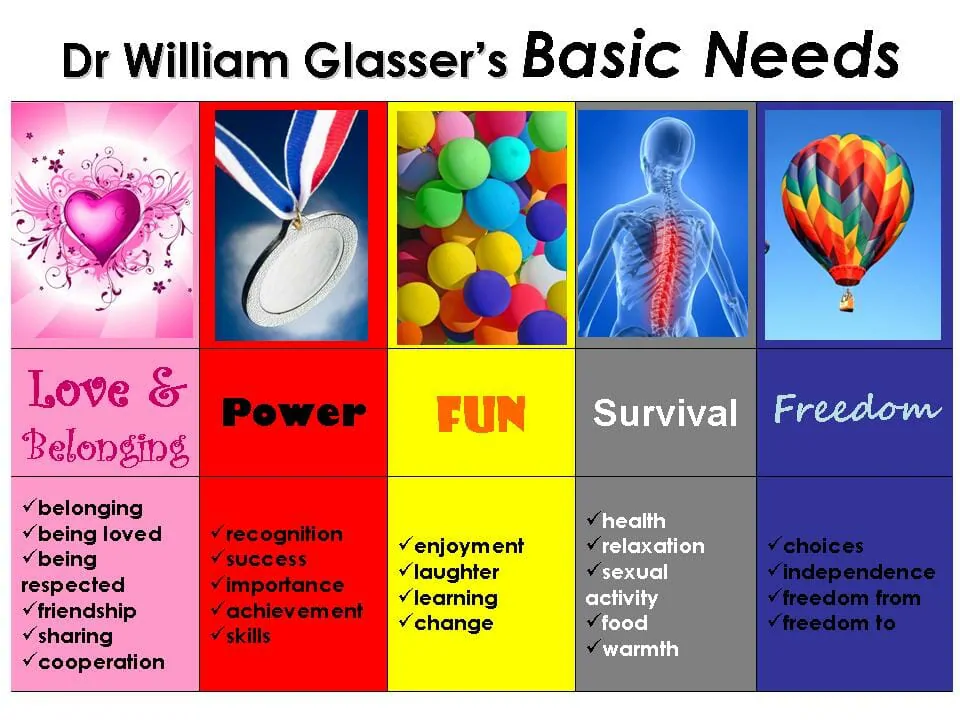
The choice theory, founded by William Glasser, suggests that all our actions are chosen and driven by the five basic needs: survival, love and belonging, power, freedom, and fun.

In relationships, our needNeed for love and belonging for love and belonging is the most important one. Based on Glasser, satisfying this specific need will guarantee our ability to fulfill all other needs. The source of all problems in the world, according to the choice theory, is disconnection. Behavior problems, mental illnesses, violence, abuse, crime, school problems, marriage breakdown, relationship challenges, and depression are all a result of our inability to connect or feel love and have a sense of belonging.

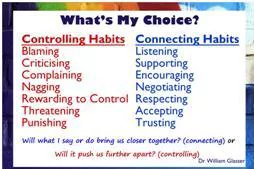
Our relationship with those we care about and care for us depends on our caring ability. Glasser suggested that there are 7 deadly habits that needed to be replaced with 7 caring habits.

Read Choice Theory: Happy Relationships »

Published: September 26, 2013 by Ronit Baras
Last modified: December 25, 2019In: Personal Development, Relationships / Marriage Tags: language, self confidence / self esteem / self worth, beliefs, personal development / personal growth / personality development / self improvement, identity, gratitude, happiness, guilt, responsibility, Life Coaching, emotional development, values, relationships / marriage, success, perception, emotional intelligence, compassion, choice, needs, trust, positive, failure, acceptance / judgment / tolerance

I’m OK, You’re OK Parenting: Being a “You’re OK” Parent

Little boy hugging little girl

In order to convince children that they are OK and good, a parent first needs to know that they are OK and good. Psychologist Thomas A. Harris. suggested four levels of emotional intelligence, that provide a framework for positive parenting. To read about the four levels, see “I’m OK, You’re OK Parenting: OK and EQ”. In an ideal world, parents would always be in an “I’m OK, You’re OK” state of mind. For this, for the parents must agree with the “I’m OK” part – they must first believe that they are OK. Once this is established, it is time to work on the “You’re OK” mindset.

Little boy and girl huggingLike a self-fulfilling prophecy, parents who see the good in themselves and their kids tend to raise kids who see the good in themselves as well. This is a great cycle. By taking care of ourselves, we ensure our children and their children know they are good and “OK”. This mindset can impact for many years even after we are gone.

Read I’m OK, You’re OK Parenting: Being a “You’re OK” Parent »

Published: September 24, 2013 by Ronit Baras
Last modified: December 25, 2019In: Emotional Intelligence Tags: acceptance / judgment / tolerance, change, self confidence / self esteem / self worth, happiness, health / wellbeing, parent coaching, personal development / personal growth / personality development / self improvement, aggressive, feeling, self-fulfilling prophecy, expectation, gratitude, activity, frustration, emotional intelligence, career, positive attitude tips, practical parenting / parents, choice, attitude, action, kids / children, beliefs

Choice Theory: Be Happy in Life

Dr. William Glasser’s 5 Basic Needs

Dr. William Glasser is an American psychiatrist who developed the Reality Theory, which later on became known as the Choice Theory. In the seventies, Glasser’s work was not highly accepted by his colleagues.

While others thought that human behavior is affected by external sources, Glasser believed in personal choice, personal responsibility, and personal transformation. While others considered certain behaviors as mental disorders and prescribed medication for these, Glasser believed in the education and empowerment of his clients to change their choices. He applied his theories on education, management, and marriage.

The Choice Theory states that a person’s behavior is inspired by what that person wants or needs at that particular time, not an outside stimulus. Glasser thought all living creatures control their behavior to fulfill their need for satisfaction in one or more of these five areas:

Read Choice Theory: Be Happy in Life »

Published: September 19, 2013 by Ronit Baras
Last modified: November 28, 2022In: Personal Development, Life Coaching Tags: perception, success, compassion, emotional intelligence, needs, choice, positive, trust, acceptance / judgment / tolerance, failure, self confidence / self esteem / self worth, language, personal development / personal growth / personality development / self improvement, beliefs, identity, guilt, gratitude, happiness, emotional development, responsibility, Life Coaching, practical parenting / parents, values

I’m OK, You’re OK Parenting: Guilt

Shadow of parent point down at sitting child

Guilt and shame are siblings in the family of feelings. Despite certain similarities, there is a clear distinction between them. Guilt is feeling bad about something you have done, while shame is feeling bad about who you are or a part of you. One is about behavior and can be changed. The other is related to your sense of identity and therefore harder to change.

In the ever evolving phases of parenting styles, the shift from physical punishment to shame was intended to use guilt more effectively than before, in the hope that it would teach children how to behave when their parents were not there. A bit like a GPS. Parents decided “guilt” was better than smacking because it worked even when mom and dad were not there. The purpose was still to monitor and control emotionally, but with good intentions; to create lasting discipline.

Read I’m OK, You’re OK Parenting: Guilt »

Published: September 5, 2013 by Ronit Baras
Last modified: June 5, 2019In: Parenting Tags: action, beliefs, identity, positive, values, cultural, emotional intelligence, acceptance / judgment / tolerance, depression, behavior / discipline, anxiety, how to, guilt, fear, emotional development, failure, practical parenting / parents

Kids Learn Through Play

Little boy in a straw hat

For children, life is a playground. They love to play. From tiny babies who hold toys and manipulate them clumsily, to school children, who play sophisticated games that require thinking, planning and manipulating, kids just love games. In fact, games are a source of calm and comfort for most. They stimulates the mind and body using a “fun incentive”.

Education in early childhood is very important in building the foundation for happy learning. The early impression children have of learning determines their attitude towards acquiring new knowledge later on in life. Researchers discovered that pre-teen children who called their learning activities “play” were more successful, happier in school and more socially content at the end of adolescence than those who considered their learning activities “work”.

Children play games for many purposes. For example, games can be used to improve social skills. During games, kids must negotiate, share, relate and connect with others. This helps develop understanding, compassion, empathy, acceptance and trust. Later on, this allows healthy intimacy.

Read Kids Learn Through Play »

Published: September 3, 2013 by Ronit Baras
Last modified: June 5, 2019In: Education / Learning Tags: emotional development, success experience, practical parenting / parents, early childhood, activity, teaching / teachers, school, fun, success, k-12 education, anxiety, academic performance, beliefs, attitude, empowerment, kids / children, motivation, self confidence / self esteem / self worth, learning styles, creative / creativity, social skills, education / learning, memory

The Wise Little Camel

Young Camel

Kids’ curiosity is amazing. Sometimes they ask questions that are so simple and so naive that we wonder how we did not ask our own parents these questions.

One of the questions all kids ask their parents is “Why do I go to school?”

You know what? Most parents do not have a good answer. Most of the time they say it is because that is what their parents did, or sometimes, just because “You have to”. Often, no questions are asked. Kids are smarter than that. They can have confidence in their schooling if their parents give a better answer to this question.

Many of the things we do today, we keep doing because we inherited this behavior from our parents and our circumstances. Often, we do not ask the question “why”. We do not try to match the things we do to the right time and circumstances.

As parents, many of us want things for our kids that have traditionally been a necessity, but are not really relevant today. We do not realize that today kids need different skills, attitudes, and knowledge. We need to match what we are teaching them with what they are going to need for life in the now.

Read The Wise Little Camel »

Published: August 27, 2013 by Ronit Baras
Last modified: December 25, 2019In: Parenting Tags: kids / children, behavior / discipline, self confidence / self esteem / self worth, personal development / personal growth / personality development / self improvement, education / learning, practical parenting / parents, skills, beliefs, attitude

Don’t Judge a Book by its Cover

Cup with 60s faces

Over the past 5 years, I have been working as the director of a not-for-profit organization dealing with diversity education. I have had the honor of working with over 20,000 kids in primary and high school and taking them through a process that helps them realize that underneath the look, the clothes, the skin color, the gender, the religion, the language and accent, there are amazingly wonderful people.

I ask all my student to fill out a feedback form. The form asks them what message they took from the workshop/presentation/activity. I have received over 20,000 feedback forms with amazing things kids write. More often than not, they write “don’t judge a book by its cover”.

In my workshops, the opportunity often presents itself to discuss our own self-judgment. I bring up the fact that it can be damaging to consider ourselves inferior based on what we look like on the outside. To illustrate my point, I share the water story. It is a great way to understand what is important in life and why what we have inside is much more important than the outside.

Read Don’t Judge a Book by its Cover »

Published: July 30, 2013 by Ronit Baras
Last modified: December 25, 2019In: Personal Development Tags: story, self-talk, attitude, diversity, acceptance / judgment / tolerance, self confidence / self esteem / self worth, personal development / personal growth / personality development / self improvement, emotional intelligence, beliefs

Raising Kids and Bamboo Trees

Bamboos by a window

Parents are often frustrated with their kids and/or with their own parenting. I coach many such parents and they express a lot of frustration. You cannot blame anyone else for the way your kids turn out and raising children is not easy, so it is not surprising that parents become frustrated. I have the most wonderful kids but they did not grow up exactly the way I expected them to. No matter how much you learn or how much you know, they will come out different to what you imagine.

This is because we are different people when we give birth to them than when we imagined them. They are born to time that is different to what we grew up with.

Patience is one of the necessary skills in the parenting job description. Sadly, no one can tell jut exactly how much patience they need until they are put to the test. They then have to find it within them.

Raising kids is similar to raising bamboo trees. Here is a story I heard called the Bamboo Tale.

Read Raising Kids and Bamboo Trees »

Published: July 18, 2013 by Ronit Baras
Last modified: December 25, 2019In: Parenting Tags: wisdom, success experience, positive, kids / children, personal development / personal growth / personality development / self improvement, frustration, practical parenting / parents, success, beliefs, empowerment

The “Why” of Sibling Rivalry

If you have siblings, you are probably going to get into conflict with them at some stage in your life. I can probably go as far as saying that if you have parents, you are probably going to end up arguing with them at some point too. Why? Because parents and siblings are pains in the backside, regardless of how much you love them.

One of my clients gave birth to her second son about 3 years after the first one was born. She says there is a constant struggle to enjoy them both at the same time. Let me explain. The eldest is magnificent, beautiful, and smart, a perfect kid. But he is so jealous of his new brother that he has become aggressive, angry, short-tempered and not fun to be around. When he spends the time with mom or dad on his own, he is completely fine, but when baby brother is around, he gets angry and upset. Mom has to make sure he does not hurt his little brother.

Read The “Why” of Sibling Rivalry »

Published: July 9, 2013 by Ronit Baras
Last modified: November 9, 2021In: Kids / Children Tags: conflict, family matters, video, kids / children, expectation, practical parenting / parents, sibling rivalry, siblings, beliefs, research

  • « Go to Previous Page
  • Page 1
  • Interim pages omitted …
  • Page 8
  • Page 9
  • Page 10
  • Page 11
  • Page 12
  • Interim pages omitted …
  • Page 50
  • Go to Next Page »

Get Happiness by Email

Sign up to receive posts by email and get my free mini-course Seven Emails with Seven Secrets for Seven Weeks to boost your personal development


    Join Us on Social Media

    Facebook logo Twitter logo Linkedin logo Pinterest logo RSS feed icon

    Books by Ronit Baras

    • What motivates your child? Read Motivating Kids by Ronit Baras Motivating Kids From: $9.95
    • Reflections by Ronit Baras Reflections From: $5.99
    • Be Special Be Yourself for Teenagers by Ronit Baras Be Special, Be Yourself for Teenagers From: $5.99
    • In the Outback with Jasmine Banks by Ronit Baras In the Outback with Jasmine Banks From: $5.99
    • The Will by Ronit Baras The Will From: $5.99

    Be Happy in LIFE logo
    Book your private life coaching with Ronit Baras and learn how to be happy in life

    Girl speaking at student leadership programLeaders are not born. They are made. Bring this Student Leadership Program to your primary school or high school and you will create a community of empowered, inspired student leaders, parents and teachers.

    Related Links

    • Be Happy in LIFE – Life Coaching
    • Noff Baras – Screen Actor & Model
    • Personal Growth Web
    • The Motivational Speaker
    • Tsoof Baras – percussionist, composer and producer

    Primary Sidebar

    Your Cart

    Speaker Bookings

    Ronit Baras - Practical Parenting Blogger
    Book Ronit as a Speaker for Your event »

    Ready to be happy?

    Happy woman holding a cup in the snow
    Be empowered and set your spirit free!

    Engage Ronit as Your Life Coach »

    Give to Receive

    Kiva - loans that change lives

    Contact Us · Subscribe · Terms of Use / Privacy Statement · Return & Refund Policy · Sitemap

    Copyright © 2026 Be Happy in LIFE · Built and powered by Get Business Online

    Secure HTTPS

    • Home
    • Series
    • About Ronit Baras
    • Books by Ronit Baras
      ▼
      • Motivating Kids
      • Be Special, Be Yourself for Teenagers
      • Reflections
      • In the Outback with Jasmine Banks
      • The Will
      • * Your Cart
      • * Secure Checkout
    • Contact
      ▼
      • Join Us