• Skip to primary navigation
  • Skip to main content
  • Skip to primary sidebar

Family MattersPractical Parenting Blog

  • Home
  • Series
  • About Ronit Baras
  • Books by Ronit Baras
    • Motivating Kids
    • Be Special, Be Yourself for Teenagers
    • Reflections
    • In the Outback with Jasmine Banks
    • The Will
    • * Your Cart
    • * Secure Checkout
  • Contact
    • Join Us

Home » acceptance / judgment / tolerance » Page 10

Damaging Kids’ Self Esteem

Mother lifting her little daughter at the pool

Self esteem is a very important ingredient for success. I have written a lot about what parents can do to support their kids’ self esteem. Unfortunately, many parents do the exact opposite and do not recognize how damaging their words can be.

Generally, there are four main attitudes that destroy self esteem:

1. Telling kids they are wrong.
2. Expressing disappointment.
3. Expressing shame.
4. Expressing doubt in the kids’ attempts.

Kids can handle a lot of pain from their parents without carrying it into adulthood. However, the four attitudes mentioned above will be carved into their hearts and determine their self esteem and attitude towards themselves.

Below is a list of 60 phrases parents say that can harm their kid’s self esteem. If you use any of these sentences, try to replace them with positive sentences instead

Read Damaging Kids’ Self Esteem »

Published: March 6, 2014 by Ronit Baras
Last modified: May 18, 2020In: Parenting Tags: happiness, positive, kids / children, acceptance / judgment / tolerance, self confidence / self esteem / self worth, emotions, communication, list, success, emotional development, empowerment, practical parenting / parents, change

The Art of Listening: Things to Watch Out For

Listen to hear, not to speak

To conclude The Art of Listening series, here are some tips on things to watch out for in deciding which listening style to adopt.

In previous posts, I covered situations when it is hard to listen, types of listening and how to become good listeners. However, putting all this into practice means you need to know when it is appropriate to adopt one style over another. There are some things to watch out for in making that decision.

Be a kind listener when:
1. The speaker is angry or in a bad mood.
2. The speaker feels judged or stressed.
3. When you want to please the listener or need something from him/her.

Read The Art of Listening: Things to Watch Out For »

Published: January 14, 2014 by Ronit Baras
Last modified: December 25, 2019In: Personal Development, Relationships / Marriage Tags: tips, acceptance / judgment / tolerance, focus, friends / friendship, emotional intelligence, personal development / personal growth / personality development / self improvement, how to, empathy, negative, feeling, change, relationships / marriage, social skills, listening, positive

The Art of Listening: How to Listen

Listen more, talk less

To wrap up our the “The Art of Listening” series , here are some great tips on how to become a better listener.

To start off, we discussed 10 situations that turn off the listening switch and make it harder to keep engaged. In the previous post, I shared four listening types: the kind listener, the empathetic listener, the critical listener and the solution focused listener.

In this post, I will share ideas of how to become a kind listener, an empathetic listener, a critical listener and a solution focused listener and how to use each of these listening styles when appropriate.

Read The Art of Listening: How to Listen »

Published: December 19, 2013 by Ronit Baras
Last modified: December 25, 2019In: Personal Development, Relationships / Marriage Tags: social, positive, questions, tips, focus, acceptance / judgment / tolerance, emotional intelligence, friends / friendship, how to, personal development / personal growth / personality development / self improvement, change, empathy, motivation, assumptions, relationships / marriage, listening

Ronit’s Tips for Developing Empathy

Empathy definition

As the state director of the Together for Humanity Foundation, I meet teachers and students to promote diversity and good relations and I believe empathy is the key. If we all had more empathy, the world would be a much better place. With more empathy, families would be happier – there would be fewer divorces and fewer problems with children.

In my work with parents and teachers, I am often asked about empathy and how others develop it. I have decided to combine all the suggestions here. If you are working with children, if you in relationship and would like to develop your own empathy, or if you want to encourage empathy in your students or children, I hope you can make good use of this list.

Read Ronit’s Tips for Developing Empathy »

Published: November 21, 2013 by Ronit Baras
Last modified: December 25, 2019In: Emotional Intelligence Tags: assessment, practical parenting / parents, body language, teaching / teachers, positive, diversity, kids / children, emotional intelligence, tips, acceptance / judgment / tolerance, role model, personal development / personal growth / personality development / self improvement, beliefs, empathy, research, emotions, divorce, feeling

What Does Children’s Behavior Mean?

Little girl in pink robe

This week, a client of mine asked about her son’s behavior. Thomas, her 3-year-old son, does not know what to do when kids take things from him. Sharon, his mum, says he starts crying immediately. She is worried that this will be his behavior in the future. She wrote in her email to me, “If a child cries when kids take toys from him, does it mean he will grow up to use crying whenever things do not go his way?”

The simple answer is:

No. Just because kids do certain things do when they are young, does not mean they will do them as adults.

Kids are inexperienced in searching for ways to get what they want. They have had limited exposure to “life” so they use more primitive and intuitive ways of getting things. When they were born, all they knew how to do was cry. And they found it to be an effective way to get what they needed. We all used crying as a method when we were babies, but that does not mean we do it now that we are grown up, at least, not in the same way.

Read What Does Children’s Behavior Mean? »

Published: October 31, 2013 by Ronit Baras
Last modified: December 25, 2019In: Ask Ronit, Kids / Children Tags: behavior / discipline, education / learning, skills, emotional development, practical parenting / parents, action, mother, social skills, conflict, social, kids / children, acceptance / judgment / tolerance

Choice Theory: Happy Parenting

You have a choice

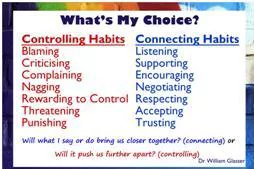
In the previous chapter of the choice theory, I explained the controlling and connecting habits—the caring or deadly habits based on William Glasser. In his theory, Glasser explained many of our behaviors as a choice. There are basic beliefs in his theory that all therapies are based on.

Based on Glasser, when we behave, it is a mix of action, thinking, feeling, and physiology. He called it “total behavior,” as they appear in different degrees and in combination.

He very much focused on taking responsibility in order to gain control and it is quite relevant to parenting.

Read Choice Theory: Happy Parenting »

Published: October 3, 2013 by Ronit Baras
Last modified: October 4, 2013In: Personal Development, Parenting Tags: perception, practical parenting / parents, emotional intelligence, compassion, role model, needs, choice, positive, trust, kids / children, failure, acceptance / judgment / tolerance, language, self confidence / self esteem / self worth, beliefs, personal development / personal growth / personality development / self improvement, gratitude, identity, responsibility, happiness, guilt, values, Life Coaching, emotional development, success

I’m OK, You’re OK Parenting: “I’m OK” Beliefs

3 children resting

This is the last installment in the “I’m OK, You’re OK Parenting” series. To wrap up, I want to share some beliefs that have helped me as a parent, and also many of my clients, to adopt an I’m OK, You’re OK parenting mentality.

The best way to overcome guilt and shame is to adopt beliefs that strengthen our view of ourselves as OK (I’m OK) and of others as OK (You’re OK) – The I’m OK, You’re OK mindset. There are many ways to identify whether you are in another frame of mind. For example, If you are upset, or disappointed, if you lecture your kids, or want them to do something they do not want to do, if you are threatening them, punishing them, shouting at them or if you want to teach them a lesson, if you shame them, use name calling, or ridicule them, and if you think life needs to go your way “or else”, this generally means you are not in the I’m OK, You’re OK mode. This means your child is also learning this mindset and will most likely not be in the I’m OK, You’re OK mode either.

Read I’m OK, You’re OK Parenting: “I’m OK” Beliefs »

Published: October 1, 2013 by Ronit Baras
Last modified: December 25, 2019In: Personal Development, Parenting Tags: beliefs, personal development / personal growth / personality development / self improvement, gratitude, identity, responsibility, happiness, guilt, values, Life Coaching, emotional development, success, perception, practical parenting / parents, emotional intelligence, compassion, role model, needs, choice, positive, trust, kids / children, failure, acceptance / judgment / tolerance, language, self confidence / self esteem / self worth

Should You Open Presents in Public?

Gift Boxes

This week, my daughter Noff came from a get-together with some of her friends. One of the friends she met had known her since primary school and had come to every one of her birthday parties, which we throw every year. She told Noff she appreciated that we never opened presents in front of the guests.

I thought that every family faces the question about opening presents in public at some point, and it is better to have a philosophy about it than to deal with the challenge again and again.

in this post, I would like to share with you my philosophy.

It all started many years ago, when I was in 2nd Grade. In my hometown, it was the tradition that on Friday evenings, children would invite their classmates to a birthday party. Luckily for me, the tradition was to invite the whole class. Otherwise, I would probably attend 3-4 birthday parties a year.

Since this was common and we had about 35-40 kids in a class, we had a birthday party roughly every week. Not all the kids were allowed do have a party at home. Since it was costly, most of the those who could have a party were rich and I was one of the poor kids. The first time I had a party at my house was when I was 17 years old.

Read Should You Open Presents in Public? »

Published: September 26, 2013 by Ronit Baras
Last modified: January 24, 2023In: Parenting Tags: choice, social skills, poll, acceptance / judgment / tolerance, practical parenting / parents

Choice Theory: Happy Relationships

Heart-shaped maze

The choice theory, founded by William Glasser, suggests that all our actions are chosen and driven by the five basic needs: survival, love and belonging, power, freedom, and fun.

In relationships, our needNeed for love and belonging for love and belonging is the most important one. Based on Glasser, satisfying this specific need will guarantee our ability to fulfill all other needs. The source of all problems in the world, according to the choice theory, is disconnection. Behavior problems, mental illnesses, violence, abuse, crime, school problems, marriage breakdown, relationship challenges, and depression are all a result of our inability to connect or feel love and have a sense of belonging.

Our relationship with those we care about and care for us depends on our caring ability. Glasser suggested that there are 7 deadly habits that needed to be replaced with 7 caring habits.

Read Choice Theory: Happy Relationships »

Published: September 26, 2013 by Ronit Baras
Last modified: December 25, 2019In: Personal Development, Relationships / Marriage Tags: language, self confidence / self esteem / self worth, beliefs, personal development / personal growth / personality development / self improvement, identity, gratitude, happiness, guilt, responsibility, Life Coaching, emotional development, values, relationships / marriage, success, perception, emotional intelligence, compassion, choice, needs, trust, positive, failure, acceptance / judgment / tolerance

I’m OK, You’re OK Parenting: Being a “You’re OK” Parent

Little boy hugging little girl

In order to convince children that they are OK and good, a parent first needs to know that they are OK and good. Psychologist Thomas A. Harris. suggested four levels of emotional intelligence, that provide a framework for positive parenting. To read about the four levels, see “I’m OK, You’re OK Parenting: OK and EQ”. In an ideal world, parents would always be in an “I’m OK, You’re OK” state of mind. For this, for the parents must agree with the “I’m OK” part – they must first believe that they are OK. Once this is established, it is time to work on the “You’re OK” mindset.

Little boy and girl huggingLike a self-fulfilling prophecy, parents who see the good in themselves and their kids tend to raise kids who see the good in themselves as well. This is a great cycle. By taking care of ourselves, we ensure our children and their children know they are good and “OK”. This mindset can impact for many years even after we are gone.

Read I’m OK, You’re OK Parenting: Being a “You’re OK” Parent »

Published: September 24, 2013 by Ronit Baras
Last modified: December 25, 2019In: Emotional Intelligence Tags: beliefs, acceptance / judgment / tolerance, change, self confidence / self esteem / self worth, happiness, health / wellbeing, parent coaching, personal development / personal growth / personality development / self improvement, aggressive, feeling, self-fulfilling prophecy, expectation, gratitude, activity, frustration, emotional intelligence, career, positive attitude tips, practical parenting / parents, choice, attitude, action, kids / children

  • « Go to Previous Page
  • Page 1
  • Interim pages omitted …
  • Page 8
  • Page 9
  • Page 10
  • Page 11
  • Page 12
  • Interim pages omitted …
  • Page 39
  • Go to Next Page »

Get Happiness by Email

Sign up to receive posts by email and get my free mini-course Seven Emails with Seven Secrets for Seven Weeks to boost your personal development


    Books by Ronit Baras

    • What motivates your child? Read Motivating Kids by Ronit Baras Motivating Kids From: $9.95
    • Reflections by Ronit Baras Reflections From: $5.99
    • Be Special Be Yourself for Teenagers by Ronit Baras Be Special, Be Yourself for Teenagers From: $5.99
    • In the Outback with Jasmine Banks by Ronit Baras In the Outback with Jasmine Banks From: $5.99
    • The Will by Ronit Baras The Will From: $5.99

    Be Happy in LIFE logo
    Book your private life coaching with Ronit Baras and learn how to be happy in life

    Girl speaking at student leadership programLeaders are not born. They are made. Bring this Student Leadership Program to your primary school or high school and you will create a community of empowered, inspired student leaders, parents and teachers.

    You’re Reading a Top Parenting Blog

    Feespot Parenting Blogs
    Top 50 Family Blog Award Top 50 Amazing Parenting Blogs 2017

    Related Links

    • Be Happy in LIFE – Life Coaching
    • Personal Growth Web
    • Tsoof Baras – percussionist, composer and producer
    • Noff Baras – Screen Actor & Model

    Primary Sidebar

    Your Cart

    Ready to be happy?

    Happy woman holding a cup in the snow
    Be empowered and set your spirit free!

    Engage Ronit as Your Life Coach »

    Speaker Bookings

    Ronit Baras - Practical Parenting Blogger
    Book Ronit as a Speaker for Your event »

    Join Us on Social Media

    Facebook logo Twitter logo Linkedin logo Pinterest logo RSS feed icon

    Give to Receive

    Kiva - loans that change lives

    Contact Us · Subscribe · Terms of Use / Privacy Statement · Return & Refund Policy · Sitemap

    Copyright © 2026 Be Happy in LIFE · Built and powered by Get Business Online

    Secure HTTPS

    • Home
    • Series
    • About Ronit Baras
    • Books by Ronit Baras
      ▼
      • Motivating Kids
      • Be Special, Be Yourself for Teenagers
      • Reflections
      • In the Outback with Jasmine Banks
      • The Will
      • * Your Cart
      • * Secure Checkout
    • Contact
      ▼
      • Join Us