• Skip to primary navigation
  • Skip to main content
  • Skip to primary sidebar

Family MattersPractical Parenting Blog

  • Home
  • Series
  • About Ronit Baras
  • Books by Ronit Baras
    • Motivating Kids
    • Be Special, Be Yourself for Teenagers
    • Reflections
    • In the Outback with Jasmine Banks
    • The Will
    • * Your Cart
    • * Secure Checkout
  • Contact
    • Join Us

Home » acceptance / judgment / tolerance » Page 11

Choice Theory: Be Happy in Life

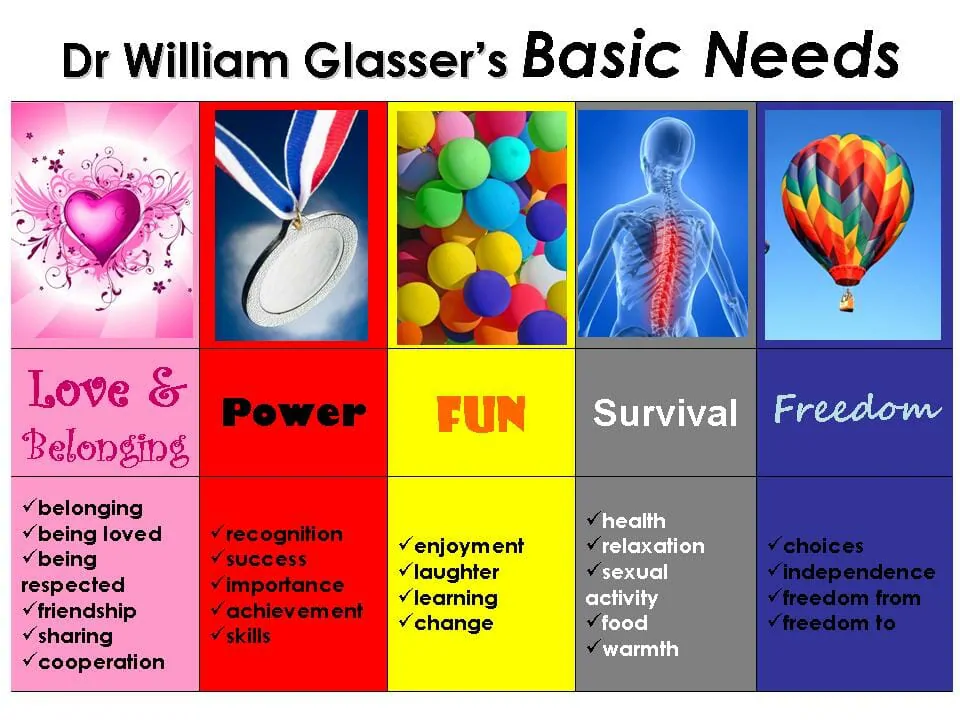
Dr. William Glasser’s 5 Basic Needs

Dr. William Glasser is an American psychiatrist who developed the Reality Theory, which later on became known as the Choice Theory. In the seventies, Glasser’s work was not highly accepted by his colleagues.

While others thought that human behavior is affected by external sources, Glasser believed in personal choice, personal responsibility, and personal transformation. While others considered certain behaviors as mental disorders and prescribed medication for these, Glasser believed in the education and empowerment of his clients to change their choices. He applied his theories on education, management, and marriage.

The Choice Theory states that a person’s behavior is inspired by what that person wants or needs at that particular time, not an outside stimulus. Glasser thought all living creatures control their behavior to fulfill their need for satisfaction in one or more of these five areas:


Read Choice Theory: Be Happy in Life »

Published: September 19, 2013 by Ronit Baras
Last modified: November 28, 2022In: Personal Development, Life Coaching Tags: emotional intelligence, needs, choice, positive, trust, acceptance / judgment / tolerance, failure, self confidence / self esteem / self worth, language, personal development / personal growth / personality development / self improvement, beliefs, identity, guilt, gratitude, happiness, emotional development, responsibility, Life Coaching, practical parenting / parents, values, perception, success, compassion

I’m OK, You’re OK Parenting: Being an “I’m OK” Parent

Loving family

In an ideal world, we would all like to be in an “I’m OK, You’re OK” state of mind all the time. People in this state are confident in themselves. They know they always do the best they can, and so does everyone else. Unfortunately, it is not always easy. Life has its own agenda and things do not always happen the way we want them to.

In parenting, circumstances make us shift from one emotional position to another. Our aim should always be to keep an “I’m OK – You’re OK” parenting style as much as possible. We may find ourselves straying to other styles, but the idea is to snap back as fast as possible.

In parent coaching we have many techniques for helping parents shift to an I’m OK, you’re OK mode. They all start by making sure parents think of themselves as “OK” first. When you are on a plane, the safety demonstration always tells you that when the oxygen mask is released, you should always put the mask on yourself first before helping your child. It works the same here. Before we can help our kids think they are OK, first we need to recognize that we are good and OK!

Read I’m OK, You’re OK Parenting: Being an “I’m OK” Parent »

Published: September 17, 2013 by Ronit Baras
Last modified: December 25, 2019In: Parenting Tags: kids / children, acceptance / judgment / tolerance, gratitude, self confidence / self esteem / self worth, emotional intelligence, health / wellbeing, choice, personal development / personal growth / personality development / self improvement, action, change, practical parenting / parents, parent coaching, activity, positive attitude tips, attitude

I’m OK, You’re OK Parenting: Parenting Styles

3 nice kids on the street

As a parent, it is important to be aware of which parenting style you use. The ideal is an “I’m OK – You’re OK” style. What’s your parenting style?

Once you know how you parent, you can slowly shift towards a more positive mindset. According to psychiatrist Thomas Harris, there are four types of parenting style:

– I’m OK – You’re OK
– I’m OK – You’re not OK
– I’m not OK – You’re OK
– I’m not OK – You’re not OK

The I’m OK – You’re OK mindset is important in all kinds of relationships: parent-child relationships, love relationships, family relationships and even work relationship.

Read I’m OK, You’re OK Parenting: Parenting Styles »

Published: September 12, 2013 by Ronit Baras
Last modified: September 24, 2015In: Parenting Tags: practical parenting / parents, control, motivation, social skills, attitude, acceptance / judgment / tolerance, self confidence / self esteem / self worth, emotions, expectation, emotional intelligence, anxiety, guilt, how to

I’m OK, You’re OK Parenting: Guilt

Shadow of parent point down at sitting child

Guilt and shame are siblings in the family of feelings. Despite certain similarities, there is a clear distinction between them. Guilt is feeling bad about something you have done, while shame is feeling bad about who you are or a part of you. One is about behavior and can be changed. The other is related to your sense of identity and therefore harder to change.

In the ever evolving phases of parenting styles, the shift from physical punishment to shame was intended to use guilt more effectively than before, in the hope that it would teach children how to behave when their parents were not there. A bit like a GPS. Parents decided “guilt” was better than smacking because it worked even when mom and dad were not there. The purpose was still to monitor and control emotionally, but with good intentions; to create lasting discipline.

Read I’m OK, You’re OK Parenting: Guilt »

Published: September 5, 2013 by Ronit Baras
Last modified: June 5, 2019In: Parenting Tags: values, cultural, emotional intelligence, acceptance / judgment / tolerance, depression, behavior / discipline, anxiety, how to, guilt, fear, emotional development, failure, practical parenting / parents, action, beliefs, identity, positive

I’m OK, You’re OK Parenting: Shame

Big communist hand pointing finger at man with bowed head

It is not easy to parent when our young kids just do not do what we want them to do. It was once popular to physically punish children for not doing what they are told. It was believed that if pain was associated with not doing what you are told, children would immediately obey.

This strategy was only useful for figures in authority (like parents and teachers). Unfortunately, it did not provide the desired outcome. Children simply learned not to get caught. If an authority figure disappeared or lost their power, the subject would revenge, big time.

After parents, there are authority figures like teachers, bosses, and managers who used shame as an alternative to physical punishment. It was a way to punish through emotional pain, without the physical pain. This seemed to work but the side effects can be severe.

Read I’m OK, You’re OK Parenting: Shame »

Published: August 13, 2013 by Ronit Baras
Last modified: December 25, 2019In: Parenting Tags: self confidence / self esteem / self worth, control, addiction, violence, anger, practical parenting / parents, aggressive, teaching / teachers, sarcasm, body image, positive, abuse, attitude, emotional intelligence, kids / children, anxiety, acceptance / judgment / tolerance, fear, behavior / discipline, trust

I’m OK, You’re OK Parenting: OK and EQ

I'm OK - You're OK book cover

In my workshops “Happy Parents Raise Happy Kids”, we discuss many aspect of parenting. One of the main topics parents bring up is that it is not easy to being a parent. I have 3 kids of my own, whose ages spread over 13 years, and I know that parenthood can be challenging.

One of the best tips I can give parents is to shift to an “I’m OK-You’re OK” parenting framework. I came across this framework over 30 years ago, in a tiny little book. I was studying at the time and was fascinated by the simplicity of it. Later on, when I started teaching kids, I adopted this mindset. It allowed me help them so much that when I had my own kids, I adopted an “I’m OK-You’re OK” parenting style. It worked like magic for me and I would like to share it with you.

Read I’m OK, You’re OK Parenting: OK and EQ »

Published: August 6, 2013 by Ronit Baras
Last modified: December 25, 2019In: Emotional Intelligence Tags: fear, feeling, books, happiness, practical parenting / parents, conflict, teaching / teachers, positive attitude tips, kids / children, tips, acceptance / judgment / tolerance, responsibility, self confidence / self esteem / self worth, emotional intelligence, personal development / personal growth / personality development / self improvement, emotions

Don’t Judge a Book by its Cover

Cup with 60s faces

Over the past 5 years, I have been working as the director of a not-for-profit organization dealing with diversity education. I have had the honor of working with over 20,000 kids in primary and high school and taking them through a process that helps them realize that underneath the look, the clothes, the skin color, the gender, the religion, the language and accent, there are amazingly wonderful people.

I ask all my student to fill out a feedback form. The form asks them what message they took from the workshop/presentation/activity. I have received over 20,000 feedback forms with amazing things kids write. More often than not, they write “don’t judge a book by its cover”.

In my workshops, the opportunity often presents itself to discuss our own self-judgment. I bring up the fact that it can be damaging to consider ourselves inferior based on what we look like on the outside. To illustrate my point, I share the water story. It is a great way to understand what is important in life and why what we have inside is much more important than the outside.

Read Don’t Judge a Book by its Cover »

Published: July 30, 2013 by Ronit Baras
Last modified: December 25, 2019In: Personal Development Tags: story, self-talk, attitude, diversity, acceptance / judgment / tolerance, self confidence / self esteem / self worth, personal development / personal growth / personality development / self improvement, emotional intelligence, beliefs

What Are You Worth?

Handful of money

Many of the people who come to the Be Happy in LIFE coaching program reveal that they have issues with their self-worth. They do not always appreciate themselves and what they have. It is up to me to shift their focus towards the great things they have in their lives or how capable they are.

Self-worth can be damaged when we face difficulties and “failures”. I put failures in quotation marks because I think every “failure” is an opportunity in disguise. I did not always think like this so I understand how hard it is for my clients to recognize it. When things do not work out the way we expect them to, they create doubt. Doubt is very debilitating.

Read What Are You Worth? »

Published: July 23, 2013 by Ronit Baras
Last modified: December 25, 2019In: Personal Development, Life Coaching Tags: values, emotional intelligence, failure, Life Coaching, positive attitude tips, acceptance / judgment / tolerance, self confidence / self esteem / self worth, personal development / personal growth / personality development / self improvement

Body Image

Body image: woman looking at a portrait of her body

The image of the ideal woman’s body has changed over the years. The change becomes obvious when you compare pictures today to pictures taken around the 17th century. The woman in the photo on the right was considered a symbol of the ultimate beauty back then.

Today, she would be considered obese. She would not dare pose for any person trying to sketch her and most definitely not naked.

You might be thinking that the 17th century was a long time ago and this photo is quite old. To this I would say that there is a woman who has been considered beautiful much more recently, and by today’s standards, she too would be considered fat: Marilyn Monroe.

Read Body Image »

Published: July 2, 2013 by Ronit Baras
Last modified: November 9, 2021In: Beautiful people Tags: overweight, society, perception, video, obesity, women, acceptance / judgment / tolerance, body image, appearance, anxiety, media, beliefs, advertising, identity, change

Teaching & Education Beliefs: Attitudes & Responsibilities

Teaching special thinkers card

Here are the last 20 of my top 100 beliefs about teaching and education. Today’s beliefs are about teacher’s attitudes and responsibilities. To read all of them, check out the Teaching & Education Beliefs.

1. In order to raise a new generation of thinkers, teaching should encourage kids to question, even it is means they question you. During my lessons, I teach the kids to question me and the world around them; we should not keep doing things just because we always have. If we do that, we never grow and evolve. Our job as teacher is not to think for them, but to teach children to think for themselves.

2. If you focus on a child’s problems, all you will see is problems. If you focus on their strengths, you will see their gifts. Teachers consider kids problematic or gifted depending on what they focus on.

“Teaching is not about what we give our students but about what they choose to take. We spend too much time giving our students information and too little teaching them how to absorb it” – Ronit Baras

Read Teaching & Education Beliefs: Attitudes & Responsibilities »

Published: June 28, 2013 by Ronit Baras
Last modified: December 25, 2019In: Parenting Tags: learning styles, intelligence, practical parenting / parents, school, k-12 education, teaching / teachers, music, kids / children, success, tips, emotional intelligence, acceptance / judgment / tolerance, beliefs, personal development / personal growth / personality development / self improvement, empowerment, creative / creativity, wisdom, education / learning, government, feeling, motivation, expectation

  • « Go to Previous Page
  • Page 1
  • Interim pages omitted …
  • Page 9
  • Page 10
  • Page 11
  • Page 12
  • Page 13
  • Interim pages omitted …
  • Page 39
  • Go to Next Page »

Get Happiness by Email

Sign up to receive posts by email and get my free mini-course Seven Emails with Seven Secrets for Seven Weeks to boost your personal development


    Books by Ronit Baras

    • What motivates your child? Read Motivating Kids by Ronit Baras Motivating Kids From: $9.95
    • Reflections by Ronit Baras Reflections From: $5.99
    • Be Special Be Yourself for Teenagers by Ronit Baras Be Special, Be Yourself for Teenagers From: $5.99
    • In the Outback with Jasmine Banks by Ronit Baras In the Outback with Jasmine Banks From: $5.99
    • The Will by Ronit Baras The Will From: $5.99

    Be Happy in LIFE logo
    Book your private life coaching with Ronit Baras and learn how to be happy in life

    Girl speaking at student leadership programLeaders are not born. They are made. Bring this Student Leadership Program to your primary school or high school and you will create a community of empowered, inspired student leaders, parents and teachers.

    You’re Reading a Top Parenting Blog

    Feespot Parenting Blogs
    Top 50 Family Blog Award Top 50 Amazing Parenting Blogs 2017

    Related Links

    • Be Happy in LIFE – Life Coaching
    • Personal Growth Web
    • Tsoof Baras – percussionist, composer and producer
    • Noff Baras – Screen Actor & Model

    Primary Sidebar

    Your Cart

    Ready to be happy?

    Happy woman holding a cup in the snow
    Be empowered and set your spirit free!

    Engage Ronit as Your Life Coach »

    Speaker Bookings

    Ronit Baras - Practical Parenting Blogger
    Book Ronit as a Speaker for Your event »

    Join Us on Social Media

    Facebook logo Twitter logo Linkedin logo Pinterest logo RSS feed icon

    Give to Receive

    Kiva - loans that change lives

    Contact Us · Subscribe · Terms of Use / Privacy Statement · Return & Refund Policy · Sitemap

    Copyright © 2026 Be Happy in LIFE · Built and powered by Get Business Online

    Secure HTTPS

    • Home
    • Series
    • About Ronit Baras
    • Books by Ronit Baras
      ▼
      • Motivating Kids
      • Be Special, Be Yourself for Teenagers
      • Reflections
      • In the Outback with Jasmine Banks
      • The Will
      • * Your Cart
      • * Secure Checkout
    • Contact
      ▼
      • Join Us