• Skip to primary navigation
  • Skip to main content
  • Skip to primary sidebar

Family MattersPractical Parenting Blog

  • Home
  • Series
  • About Ronit Baras
  • Books by Ronit Baras
    • Motivating Kids
    • Be Special, Be Yourself for Teenagers
    • Reflections
    • In the Outback with Jasmine Banks
    • The Will
    • * Your Cart
    • * Secure Checkout
  • Contact
    • Join Us

Home » values » Page 5

My Anti -TV campaign

As an advocate of emotional intelligence, I object to kids watching TV. Everything I try to give them, the TV is destroying. I think bringing a TV home is like bringing the opposition into your living room, to tell your kids that you, the parent is wrong. Why would you do that?

When Eden was young and we were a young couple, we did not have a TV at home. My grandmother, who wanted to buy a new TV, suggested we take hers and we refused. We worked and when we were home, there were better things to do with our time than watch TV. Some family members and friends thought we were nuts and that we were not preparing our daughter to live in the real world. 24 years later, I can tell you, she is prepared for the real world, maybe even better than many other kids her age.

A month ago, Brisbane experienced a huge storm and trees were up rooted not far from us (it was really scary). Many houses experienced major damage and were without electricity for days (Many difficulties pop up when you do not have electricity for 3 days. We depend on electricity so much). We were the lucky ones. The only thing that happened to us was that our 20 year old 25 inch TV shorted (even though it had a surge protector). Tsoof and Gal were very happy because they have been wanting to buy a new TV for a year. Eden and I were not very happy. We ended up buying a huge TV with the promise to only watch videos and minimize watching TV.

Read My Anti -TV campaign »

Published: March 19, 2013 by Ronit Baras
Last modified: November 9, 2021In: Parenting Tags: television, home / house, tv, responsibility, family matters, values, technology, emotional intelligence, decision making, negative, kids / children, computer, teens / teenagers, mother, parenting teens, father, acceptance / judgment / tolerance, mom, movies, dad, practical parenting / parents

Consistency is Key to Good Parenting

In my last post, I Learned it From the Best we talked about how influential parenting is for a child’s future. In the long term, some things parents do are positive and some are negative. But which ones are positive? Which parenting styles are good for your children? In this post, I want to go into detail about the importance of consistency – the value of giving consistent rewards, punishments, attention and praise.

In early childhood, parenting in general gives children a toolkit of skills and beliefs they can take with them. It helps them deal with the challenges that life puts in their paths. If parents give their child positive, useful tools, then they are well equipped for the future. Things like praise and attention give confidence. On the other hand, parents who give their children bad habits and poor attitudes are setting them up for struggle. Addictive behaviors and poor eating habits are examples of unhelpful tools.

Read Consistency is Key to Good Parenting »

Published: March 7, 2013 by Eden Baras
Last modified: March 19, 2021In: Parenting Tags: practical parenting / parents, how to, conflict, role model, family matters, negative, budget, beliefs, academic performance, divorce, positive attitude tips, separation, positive, mother, attitude, father, stress / pressure, values, mom, behavior / discipline, money, dad, certainty, anxiety, relationships / marriage

Kids Cheating with Mobile Phones: Who is to Blame?

Schools struggle a lot with the increased use of mobile phones by children. Many new regulations are in place to stop children from bringing mobile phone to school. At a primary school level, some schools ask the students to deposit their mobile phones at the office. In high schools, the phone devices are part of everyday life and a regular item in each class. In the past, teachers had to deal with the concentration and focus of the children. Now, they need to fight the attraction of the mobile phones as well!

With the introduction of mobile phones, one new problem that teachers to deal with is cheating on tests. In the past, students had to think of very sophisticated ways of writing cheat shits on paper, on their hand, the back of the ruler or the calculator. Kids today have a very handy way to keep the information and they use it well.

A survey conducted by a media sources with some common sense discovered that a third of teens with mobiles admitted to storing information on their phone, using it in an exam or texting their friends the answers while their friends are in the exam.

Read Kids Cheating with Mobile Phones: Who is to Blame? »

Published: February 28, 2013 by Ronit Baras
Last modified: June 7, 2023In: Kids / Children, Education / Learning Tags: parenting teens, school, intelligence, behavior / discipline, values, anger, health / wellbeing, art, family matters, creative / creativity, assessment, education / learning, fear, technology, practical parenting / parents, choice, k-12 education, teaching / teachers, internet, academic performance, digital, attitude, research, kids / children, change, teens / teenagers, memory

Make a List: Inspiring People

Inspiration is contagious. It is the act of giving without the intention of giving that touches people at their core and helps them move forward towards being better, stronger people.

When I take stock of my life, my behavior, my attitude, beliefs and feelings, I often discover that other people have contributed greatly to who I am. When people have contributed in a bad way, I say that because of them or something that happened with them, I got stuck in a bad place in my life. In a sense, I am blaming them for being part of my life. When they have contributed in a good way, I say they have inspired me or encouraged me to reach where I am now. I am grateful and happy that they have been part of my journey.

It is not by accident that when people see a psychologist to figure out something that bothers them in life, they end up talking about their parents or siblings. These people are major contributors to who we are. Regardless of our relationship with our own families in the present, our parents, brothers and sisters influenced us mainly because of the many years we spend together, often through critical times during our life (read Divorcing Your Parents and people’s comments and you will find out how many parents have failed to inspire their children who are now adults).

My mom and dad influenced me in different ways, because they were totally different people. As a kid, I had lots of criticism towards them. When I started my personal growth experience at the age of 16 (lucky me, I was young), I changed the question from “How did they screw up my life?” to “How did each of them inspire me?” It is amazing how many great answers I have received.

Read Make a List: Inspiring People »

Published: August 20, 2012 by Ronit Baras
Last modified: March 18, 2021In: Personal Development Tags: identity, change, happiness, motivation, relationships / marriage, values, positive, inspiration, emotional intelligence, self confidence / self esteem / self worth, how to, personal development / personal growth / personality development / self improvement, negative, practical parenting / parents, beliefs

Easy Divorce

Everybody also knows that divorce is painful to all involved. Regardless of your circumstances, both partners and all their children get hurt. Yet, the rate of divorce is soaring and being single again after having children is now part of many parents’ lives. Divorce seems hard to go through, but awfully easy to choose.

In the past, divorce was unacceptable in many societies. Once people got married, which was often by parental arrangement, they were stuck with their partners for life. Marriage was literally “until death do us part”. Being married for life was what everybody did. The average divorce rate was 0%.

Believing that ending their marriage while both partners were alive was not an option, the only available course of action was to make the marriage work. Sometimes, that was just as much fun as digging holes, but everyone dug 7 a day and kept their mouths shut.

Now, when you try to make a marriage work and you are committed to it for the long haul, you make decisions accordingly. You join bank accounts, split the responsibilities for best household performance and comfort, do your best to get to know your partner and try to be accommodating. In return, you could also rely on your partner to be there for you in times of difficulty, simply because he or she was as committed to the marriage as you were.

Read Easy Divorce »

Published: April 4, 2012 by Gal Baras
Last modified: December 25, 2019In: Relationships / Marriage Tags: how to, attitude, choice, acceptance / judgment / tolerance, beliefs, behavior / discipline, divorce, relationships / marriage, social skills, focus, romance, love, society, responsibility, lifestyle, values, family matters, emotional intelligence, self-fulfilling prophecy

State of the Union

As a parent, a life coach, a business consultant and a former corporate employee and manager, I have become increasingly concerned about morals. Until recently, I read or heard about people doing things that seem obviously wrong to do, and wondered how they could bring themselves to do them.

Now, I believe I know some of the reasons. Better yet, perhaps these reasons can lead us all towards a solution.

Almost invariably, you turn on the news or read the papers and find out about somebody who was caught scheming, embezzling or downright cheating. These people seem to have no regard for other people’s wellbeing, possessions or money. Sometimes, people are killed over what seems like a minor conflict, because the killer values something else – their wallet, their leather jacket or their girlfriend – over their life.

In response to Ronit’s posts on bullying, many readers have shared stories of workplace bullies who abuse their position, physical size or some weakness of their co-workers in ways that hurt them and ruins morale and productivity. Do these people follow a different value system to the rest of us? Given the rise of bullying, probably not.

So what is going on in the world? Has everybody gone mad? Is there nobody who still does the right things?

In his great book, Predictably Irrational, Dan Ariely presents a conflict between two modes of living: the “social norm” and the “market norm”.

Read State of the Union »

Published: March 14, 2012 by Gal Baras
Last modified: March 19, 2021In: Parenting Tags: leadership, change, behavior / discipline, motivation, personal development / personal growth / personality development / self improvement, relationships / marriage, education / learning, social skills, practical parenting / parents, community, responsibility, society, values, lifestyle, emotional intelligence, bullying, how to, k-12 education, role model, academic performance, choice

How to Manage Difficult People: A Holistic Approach

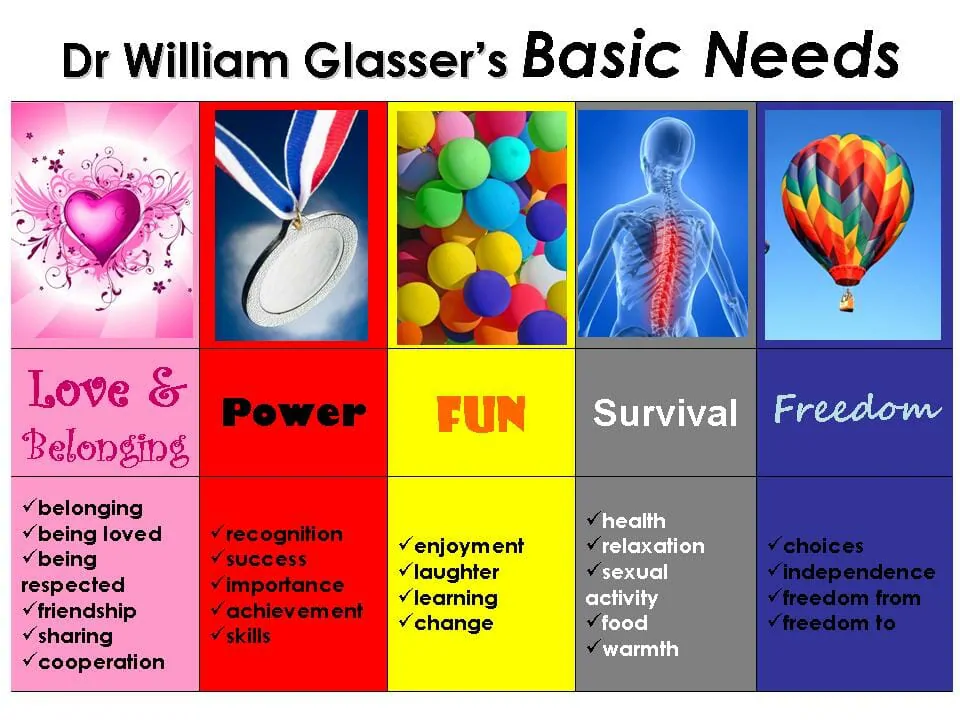
We all have “need tanks” and they are full or empty due to the circumstances in our life. We can direct some of the events that influence us, but we cannot direct all of them. We cannot control everything that happens to us in life, but we can control what we do about it and learn to keep our balance.

If you lose your job, your certainty tank is emptied all of a sudden. If you divorce, your love and connection tank goes down so quickly your life will be hard for a while. If you have a new job and you need to work exactly at the same times of the day and you need to accumulate lots of working days until you can have a holiday, then your variety level is at risk. If you have just joined a sewing club, where everyone there is so advanced you need to catch up, then your significance may suffer.

Personal development is a very good way to learn to fill our tanks. We learn to balance ourselves by discovering who we are, how we think, how we function and what makes us happy and successful. It is very important to know that the balance is different from one person to another. What one sees balance might feel out of balance for another. When we consider needs, they also contradict each other sometimes.

Conflicting needs

Our four needs are in constant conflict with each other and require each person to balance them based on his or her definition of balance.

Read How to Manage Difficult People: A Holistic Approach »

Published: March 12, 2012 by Ronit Baras
Last modified: December 25, 2019In: Parenting, Relationships / Marriage Tags: how to, friends / friendship, change, personal development / personal growth / personality development / self improvement, motivation, relationships / marriage, practical parenting / parents, social skills, family matters, bullying, communication, needs, responsibility, acceptance / judgment / tolerance, values, behavior / discipline, emotional intelligence, self confidence / self esteem / self worth

How to Manage Difficult People Using "Why?" and "What?"

Difficult behavior is always a sign that there is an unfulfilled need. Most of the time, everybody focuses on the desires the difficult people express and not on their needs, while the difficult people are so stuck on what they want that they are not at all in a position to fulfill their own needs.

That can be changed by you helping them find what they need and by helping them get it.

The following technique was developed by observing 2- and 3-year-old kids. At the age of 2, they start with the question phase. Here is a typical discussion I have had with my own children and many kids I have worked with.

“What’s this?”

“It’s a card game?”

“What’s a card game?”

“It’s a pack of cards with things printed on them that we use to play a matching game”.

“What’s a matching game?”

“It’s a game where you have two cards that look exactly the same and you have to find them out of all the cards”.

“Why do we have to play a matching game?”

“It’s good for our brain. We learn to recognize things that are the same and others that are different”.

“Why is it good for our brain?”

And this conversation can go on forever if I could manage answering questions forever. The trick is always to answer calmly. It is a game, a very healthy game, and children learn a lot from it. You could say that this type of questioning is difficult behavior, but I think it is your reaction that makes it a learning experience or a difficult behavior. If you answer calmly, it is a learning experience. If you answer with anger, it becomes a difficult behavior.

Read How to Manage Difficult People Using "Why?" and "What?" »

Published: March 5, 2012 by Ronit Baras
Last modified: December 25, 2019In: Parenting, Relationships / Marriage Tags: how to, friends / friendship, change, personal development / personal growth / personality development / self improvement, motivation, relationships / marriage, practical parenting / parents, social skills, family matters, bullying, communication, needs, responsibility, acceptance / judgment / tolerance, values, behavior / discipline, emotional intelligence, self confidence / self esteem / self worth

How to Manage Difficult People: Helping a Difficult Person

As you have seen in the previous post, every difficult behavior can be mapped to an unfulfilled need that the “difficult person” cannot find other ways to fulfill. Each need is a strong belief that they must have something, they cannot live without it and they can only get it by “being difficult”.

Now that you understand the missing feeling that difficult people are searching for, you are probably asking yourself, “What do I do to give it to them?”

One of the biggest challenges of helping and supporting difficult people is the fear that giving them what they want will make them think their obnoxious behavior is a good strategy of getting what they want and it will only make things worse. I have heard this claim millions of times when working with children – “If a child is behaving in a bad way and you give him what he wants, he learns that this is a legitimate way to get what he wants”.

Well, that is not the case.

Focus on needs, not desires

There is a big difference between giving children what they say they want and giving them what they need. Much like difficult people, children do not know that they behave the way the do to fulfill a need. If they knew, they would give themselves that thing without the difficult behavior.

If you focus on giving them what they need, then after a while, when the need is fulfilled, they will calm down and ease their demands. I am not saying, “Give them what they want”, I am saying, “Give them what they really need”. Give them what they are missing, because they do not know how to give it to themselves and may not even know what it is.

Read How to Manage Difficult People: Helping a Difficult Person »

Published: February 27, 2012 by Ronit Baras
Last modified: December 25, 2019In: Parenting, Relationships / Marriage Tags: self confidence / self esteem / self worth, how to, friends / friendship, change, personal development / personal growth / personality development / self improvement, motivation, relationships / marriage, practical parenting / parents, social skills, family matters, bullying, communication, needs, responsibility, acceptance / judgment / tolerance, values, behavior / discipline, emotional intelligence

How to Manage Difficult People: What They Really Need

Let’s say you are willing to make the effort to manage the difficult people in your life and help them get the feeling they are missing, the feeling that causes them to behave the way they do. How can you tell what is the feeling they really need?

Needs are a complex issue. They are feelings that are so strong that you believe you cannot live without them. Each person’s needs are very individual, but they definitely get them out of control. If you can control a need, it is no longer a need but more of a preference.

Many people confuse wishes, desires, preferences, values and needs. Although they all have something in common, they differ in intensity.

If you have a discussion or an interaction with a difficult person and you feel their demands are a bit too strong and that they are having a little panic about their request, ask them, “What will happen if you don’t get it?” or “What will happen if things don’t happen the way you want them?” or “What’s the worst thing that can happen?”

This question creates a loop in their brain and the answer does not matter. Their subconscious will answer itself and lower the difficult person’s tension from “I absolutely must have it” to “OK, well, I won’t die without it, so maybe it’s not the end of the world after all”.

Read How to Manage Difficult People: What They Really Need »

Published: February 20, 2012 by Ronit Baras
Last modified: December 25, 2019In: Parenting, Relationships / Marriage Tags: emotional intelligence, self confidence / self esteem / self worth, how to, friends / friendship, change, personal development / personal growth / personality development / self improvement, motivation, relationships / marriage, practical parenting / parents, social skills, family matters, bullying, communication, needs, responsibility, acceptance / judgment / tolerance, values, behavior / discipline

  • « Go to Previous Page
  • Page 1
  • Interim pages omitted …
  • Page 3
  • Page 4
  • Page 5
  • Page 6
  • Page 7
  • Interim pages omitted …
  • Page 12
  • Go to Next Page »

Get Happiness by Email

Sign up to receive posts by email and get my free mini-course Seven Emails with Seven Secrets for Seven Weeks to boost your personal development


    Books by Ronit Baras

    • What motivates your child? Read Motivating Kids by Ronit Baras Motivating Kids From: $9.95
    • Reflections by Ronit Baras Reflections From: $5.99
    • Be Special Be Yourself for Teenagers by Ronit Baras Be Special, Be Yourself for Teenagers From: $5.99
    • In the Outback with Jasmine Banks by Ronit Baras In the Outback with Jasmine Banks From: $5.99
    • The Will by Ronit Baras The Will From: $5.99

    Be Happy in LIFE logo
    Book your private life coaching with Ronit Baras and learn how to be happy in life

    Girl speaking at student leadership programLeaders are not born. They are made. Bring this Student Leadership Program to your primary school or high school and you will create a community of empowered, inspired student leaders, parents and teachers.

    You’re Reading a Top Parenting Blog

    Feespot Parenting Blogs
    Top 50 Family Blog Award Top 50 Amazing Parenting Blogs 2017

    Related Links

    • Be Happy in LIFE – Life Coaching
    • Personal Growth Web
    • Tsoof Baras – percussionist, composer and producer
    • Noff Baras – Screen Actor & Model

    Primary Sidebar

    Your Cart

    Ready to be happy?

    Happy woman holding a cup in the snow
    Be empowered and set your spirit free!

    Engage Ronit as Your Life Coach »

    Speaker Bookings

    Ronit Baras - Practical Parenting Blogger
    Book Ronit as a Speaker for Your event »

    Join Us on Social Media

    Facebook logo Twitter logo Linkedin logo Pinterest logo RSS feed icon

    Give to Receive

    Kiva - loans that change lives

    Contact Us · Subscribe · Terms of Use / Privacy Statement · Return & Refund Policy · Sitemap

    Copyright © 2026 Be Happy in LIFE · Built and powered by Get Business Online

    Secure HTTPS

    • Home
    • Series
    • About Ronit Baras
    • Books by Ronit Baras
      ▼
      • Motivating Kids
      • Be Special, Be Yourself for Teenagers
      • Reflections
      • In the Outback with Jasmine Banks
      • The Will
      • * Your Cart
      • * Secure Checkout
    • Contact
      ▼
      • Join Us