• Skip to primary navigation
  • Skip to main content
  • Skip to primary sidebar

Family MattersPractical Parenting Blog

  • Home
  • Series
  • About Ronit Baras
  • Books by Ronit Baras
    • Motivating Kids
    • Be Special, Be Yourself for Teenagers
    • Reflections
    • In the Outback with Jasmine Banks
    • The Will
    • * Your Cart
    • * Secure Checkout
  • Contact
    • Join Us

Home » responsibility » Page 7

Raising Older Parents

Old couple sitting on a bench a sunset

Recently, I travelled overseas to visit my family. While there, I spent a fair bit of time with my parents who are both getting on in age. My father is 80+ and my mother recently turned 73. Surprisingly, my dad is the healthier of the two. My mom on the other hand, has been not healthy for as long as I can remember her. First it was high blood pressure, then diabetes, cholesterol, obesity, osteoporosis and the list goes on.

Even though my visit was only for a short time, my mother and her health issues were a drama once again. Thankfully, she is not what you would call “sick”. As in, she does not have a fatal illness or anything like that. She just always seems to be in pain, or complaining about her physical condition. She visits her doctor regularly and often ends up telling them exactly what she wants them to prescribe for her. If you ask how she is, she will immediately start telling you. My sister, who is a social worker, says this is simply part of getting old. That may be, but my dad is older than her and he is not like that. I have met other people the same age, and even older, that were not like that either. I find it hard to accept that this is part of getting old.

Read Raising Older Parents »

Published: November 14, 2013 by Ronit Baras
Last modified: December 25, 2019In: Health / Wellbeing Tags: practical parenting / parents, mother, father, mom, dad, poll, obesity, responsibility, attitude, beliefs, grandparents, health / wellbeing, control, thought, mind

Choice Theory: Happy Teachers

surccess or failure

In the previous blog posts, I explained how to use the choice theory in the classroom, fulfilling the student’s basic needs. As I said in the blog post about business, bosses and managers, we can consider the teacher as a manager, the boss of the class, or the leader of the class.

I have been running workshops for teachers for many years. I am shocked 100% of the time to discover that 3 or 4 years of teaching degree focuses mainly on curriculum and lesson plans and nothing on the teachers’ emotional intelligence or leadership abilities. In 100% of all my workshops, the teachers feel disappointed the information was not available for them before they started their teaching career.

Still, we can all choose to adopt this method of teaching at any time. What I tell them is, “It is never too late to start choosing differently. In the past, you didn’t know about this, so there was nothing to choose from. Now that you have the option whether to adopt or not, you can practice your choice muscle.”

Read Choice Theory: Happy Teachers »

Published: October 24, 2013 by Ronit Baras
Last modified: October 24, 2013In: Personal Development, Education / Learning, Emotional Intelligence Tags: academic performance, kids / children, personal development / personal growth / personality development / self improvement, education / learning, communication, teaching / teachers, school, responsibility, emotional intelligence, compassion

Choice Theory: Happy Business

Which direction to take?

In the last two posts on “choice theory,” I covered William Glasser’s reality theory and the seven deadly and caring habits and their impact on relationships and parenting.

Glasser’s choice theory helped not just individuals but also organizations like schools and businesses to enable management, workers, and students to take part in the system using internal motivation and avoid conflicts.

Every business transaction (and schooling is similar) is a transaction in relationship. We call good relationship a good business transaction, and conflict, anger, disappointment, and frustration a bad business transaction. For a business to succeed, it needs to establish good relationship between all participants and connect well. Glasser called it “Lead Management.” Using the choice theory in business, employees, managers, suppliers, and clients replace external control with internal control based on happy and successful relationship and are very much dependent on the managers, who lead the organizations.

Read Choice Theory: Happy Business »

Published: October 10, 2013 by Ronit Baras
Last modified: October 10, 2013In: Emotional Intelligence Tags: evaluation, choice, guilt, failure, identity, Life Coaching, communication styles, listening, gratitude, decision making, responsibility, leadership, success, personal development / personal growth / personality development / self improvement, emotional intelligence

Choice Theory: Happy Parenting

You have a choice

In the previous chapter of the choice theory, I explained the controlling and connecting habits—the caring or deadly habits based on William Glasser. In his theory, Glasser explained many of our behaviors as a choice. There are basic beliefs in his theory that all therapies are based on.

Based on Glasser, when we behave, it is a mix of action, thinking, feeling, and physiology. He called it “total behavior,” as they appear in different degrees and in combination.

He very much focused on taking responsibility in order to gain control and it is quite relevant to parenting.

Read Choice Theory: Happy Parenting »

Published: October 3, 2013 by Ronit Baras
Last modified: October 4, 2013In: Personal Development, Parenting Tags: failure, acceptance / judgment / tolerance, language, self confidence / self esteem / self worth, beliefs, personal development / personal growth / personality development / self improvement, gratitude, identity, responsibility, happiness, guilt, values, Life Coaching, emotional development, success, perception, practical parenting / parents, emotional intelligence, compassion, role model, needs, choice, positive, trust, kids / children

I’m OK, You’re OK Parenting: “I’m OK” Beliefs

3 children resting

This is the last installment in the “I’m OK, You’re OK Parenting” series. To wrap up, I want to share some beliefs that have helped me as a parent, and also many of my clients, to adopt an I’m OK, You’re OK parenting mentality.

The best way to overcome guilt and shame is to adopt beliefs that strengthen our view of ourselves as OK (I’m OK) and of others as OK (You’re OK) – The I’m OK, You’re OK mindset. There are many ways to identify whether you are in another frame of mind. For example, If you are upset, or disappointed, if you lecture your kids, or want them to do something they do not want to do, if you are threatening them, punishing them, shouting at them or if you want to teach them a lesson, if you shame them, use name calling, or ridicule them, and if you think life needs to go your way “or else”, this generally means you are not in the I’m OK, You’re OK mode. This means your child is also learning this mindset and will most likely not be in the I’m OK, You’re OK mode either.

Read I’m OK, You’re OK Parenting: “I’m OK” Beliefs »

Published: October 1, 2013 by Ronit Baras
Last modified: December 25, 2019In: Personal Development, Parenting Tags: emotional intelligence, compassion, role model, needs, choice, positive, trust, kids / children, failure, acceptance / judgment / tolerance, language, self confidence / self esteem / self worth, beliefs, personal development / personal growth / personality development / self improvement, gratitude, identity, responsibility, happiness, guilt, values, Life Coaching, emotional development, success, perception, practical parenting / parents

Choice Theory: Happy Relationships

Heart-shaped maze

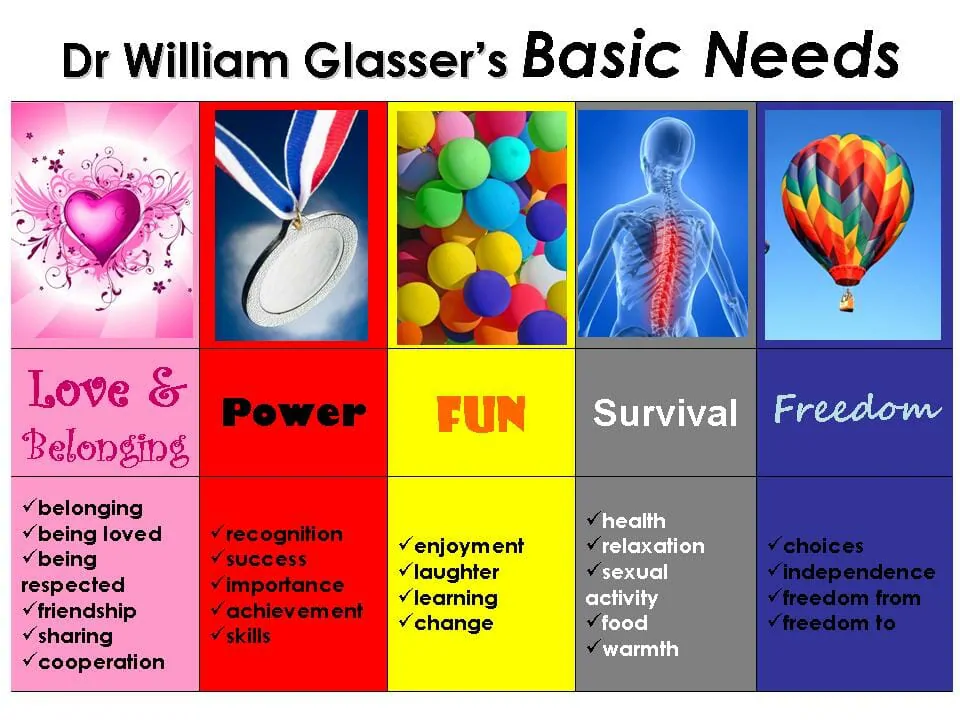
The choice theory, founded by William Glasser, suggests that all our actions are chosen and driven by the five basic needs: survival, love and belonging, power, freedom, and fun.

In relationships, our needNeed for love and belonging for love and belonging is the most important one. Based on Glasser, satisfying this specific need will guarantee our ability to fulfill all other needs. The source of all problems in the world, according to the choice theory, is disconnection. Behavior problems, mental illnesses, violence, abuse, crime, school problems, marriage breakdown, relationship challenges, and depression are all a result of our inability to connect or feel love and have a sense of belonging.

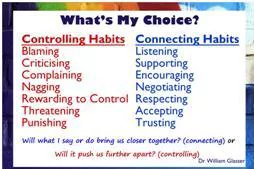
Our relationship with those we care about and care for us depends on our caring ability. Glasser suggested that there are 7 deadly habits that needed to be replaced with 7 caring habits.

Read Choice Theory: Happy Relationships »

Published: September 26, 2013 by Ronit Baras
Last modified: December 25, 2019In: Personal Development, Relationships / Marriage Tags: beliefs, personal development / personal growth / personality development / self improvement, identity, gratitude, happiness, guilt, responsibility, Life Coaching, emotional development, values, relationships / marriage, success, perception, emotional intelligence, compassion, choice, needs, trust, positive, failure, acceptance / judgment / tolerance, language, self confidence / self esteem / self worth

Choice Theory: Be Happy in Life

Dr. William Glasser’s 5 Basic Needs

Dr. William Glasser is an American psychiatrist who developed the Reality Theory, which later on became known as the Choice Theory. In the seventies, Glasser’s work was not highly accepted by his colleagues.

While others thought that human behavior is affected by external sources, Glasser believed in personal choice, personal responsibility, and personal transformation. While others considered certain behaviors as mental disorders and prescribed medication for these, Glasser believed in the education and empowerment of his clients to change their choices. He applied his theories on education, management, and marriage.

The Choice Theory states that a person’s behavior is inspired by what that person wants or needs at that particular time, not an outside stimulus. Glasser thought all living creatures control their behavior to fulfill their need for satisfaction in one or more of these five areas:

Read Choice Theory: Be Happy in Life »

Published: September 19, 2013 by Ronit Baras
Last modified: November 28, 2022In: Personal Development, Life Coaching Tags: success, compassion, emotional intelligence, needs, choice, positive, trust, acceptance / judgment / tolerance, failure, self confidence / self esteem / self worth, language, personal development / personal growth / personality development / self improvement, beliefs, identity, guilt, gratitude, happiness, emotional development, responsibility, Life Coaching, practical parenting / parents, values, perception

I’m OK, You’re OK Parenting: OK and EQ

I'm OK - You're OK book cover

In my workshops “Happy Parents Raise Happy Kids”, we discuss many aspect of parenting. One of the main topics parents bring up is that it is not easy to being a parent. I have 3 kids of my own, whose ages spread over 13 years, and I know that parenthood can be challenging.

One of the best tips I can give parents is to shift to an “I’m OK-You’re OK” parenting framework. I came across this framework over 30 years ago, in a tiny little book. I was studying at the time and was fascinated by the simplicity of it. Later on, when I started teaching kids, I adopted this mindset. It allowed me help them so much that when I had my own kids, I adopted an “I’m OK-You’re OK” parenting style. It worked like magic for me and I would like to share it with you.

Read I’m OK, You’re OK Parenting: OK and EQ »

Published: August 6, 2013 by Ronit Baras
Last modified: December 25, 2019In: Emotional Intelligence Tags: personal development / personal growth / personality development / self improvement, emotions, fear, feeling, books, happiness, practical parenting / parents, conflict, teaching / teachers, positive attitude tips, kids / children, tips, acceptance / judgment / tolerance, responsibility, self confidence / self esteem / self worth, emotional intelligence

Teaching & Education Beliefs: Caring

Education

Previously on Teaching & Education Beliefs, I wrote it was the last set of beliefs, but they were not. Sorry. Today’s beliefs are. Here are the last 20 of my top 100 beliefs about teaching and education.

All kids are gifted. Every child has some talent or skill. Teachers are there to help them develop and excel in it. But remember, numeracy and literacy skills are not the only gifts available and they are not great predictors of excellence in the future.

Kids’ hobbies are very important for their emotional intelligence, more than their academic success. Encourage kids to have hobbies, share yours with them, introduce them to different people with different hobbies and give a stage in class to share theirs.

Read Teaching & Education Beliefs: Caring »

Published: July 4, 2013 by Ronit Baras
Last modified: December 25, 2019In: Education / Learning Tags: special education, questions, responsibility, kids / children, emotional intelligence, behavior / discipline, language, education / learning, beliefs, wisdom, hobbies, learning styles, assumptions, intelligence, evaluation, self-fulfilling prophecy, teaching / teachers, k-12 education, academic performance

Teaching & Education Beliefs: Use Your Power

Book: Teachers are people

Here are 20 more of my top 100 beliefs about teaching and education:

1. Teaching is the business of manipulating students to think they are smart, wonderful, talented, pretty, successful, happy, healthy and wealthy. Whether we like it or not, us teachers have a lot of power over what our students think about themselves. Do not feel guilty. It is part of the job description. Just be sure to use this power wisely.

2. When I am upset with my students I think of them as the cutest babies. My anger dissolves.

Read Teaching & Education Beliefs: Use Your Power »

Published: June 13, 2013 by Ronit Baras
Last modified: December 25, 2019In: Education / Learning Tags: k-12 education, school, social, responsibility, academic performance, success, positive, emotional intelligence, attitude, beliefs, kids / children, empowerment, education / learning, social skills, success experience, teaching / teachers, environment, vacation

  • « Go to Previous Page
  • Page 1
  • Interim pages omitted …
  • Page 5
  • Page 6
  • Page 7
  • Page 8
  • Page 9
  • Interim pages omitted …
  • Page 23
  • Go to Next Page »

Get Happiness by Email

Sign up to receive posts by email and get my free mini-course Seven Emails with Seven Secrets for Seven Weeks to boost your personal development


    Books by Ronit Baras

    • What motivates your child? Read Motivating Kids by Ronit Baras Motivating Kids From: $9.95
    • Reflections by Ronit Baras Reflections From: $5.99
    • Be Special Be Yourself for Teenagers by Ronit Baras Be Special, Be Yourself for Teenagers From: $5.99
    • In the Outback with Jasmine Banks by Ronit Baras In the Outback with Jasmine Banks From: $5.99
    • The Will by Ronit Baras The Will From: $5.99

    Be Happy in LIFE logo
    Book your private life coaching with Ronit Baras and learn how to be happy in life

    Girl speaking at student leadership programLeaders are not born. They are made. Bring this Student Leadership Program to your primary school or high school and you will create a community of empowered, inspired student leaders, parents and teachers.

    You’re Reading a Top Parenting Blog

    Feespot Parenting Blogs
    Top 50 Family Blog Award Top 50 Amazing Parenting Blogs 2017

    Related Links

    • Be Happy in LIFE – Life Coaching
    • Personal Growth Web
    • Tsoof Baras – percussionist, composer and producer
    • Noff Baras – Screen Actor & Model

    Primary Sidebar

    Your Cart

    Ready to be happy?

    Happy woman holding a cup in the snow
    Be empowered and set your spirit free!

    Engage Ronit as Your Life Coach »

    Speaker Bookings

    Ronit Baras - Practical Parenting Blogger
    Book Ronit as a Speaker for Your event »

    Join Us on Social Media

    Facebook logo Twitter logo Linkedin logo Pinterest logo RSS feed icon

    Give to Receive

    Kiva - loans that change lives

    Contact Us · Subscribe · Terms of Use / Privacy Statement · Return & Refund Policy · Sitemap

    Copyright © 2026 Be Happy in LIFE · Built and powered by Get Business Online

    Secure HTTPS

    • Home
    • Series
    • About Ronit Baras
    • Books by Ronit Baras
      ▼
      • Motivating Kids
      • Be Special, Be Yourself for Teenagers
      • Reflections
      • In the Outback with Jasmine Banks
      • The Will
      • * Your Cart
      • * Secure Checkout
    • Contact
      ▼
      • Join Us