• Skip to primary navigation
  • Skip to main content
  • Skip to primary sidebar

Family MattersPractical Parenting Blog

  • Home
  • Series
  • About Ronit Baras
  • Books by Ronit Baras
    • Motivating Kids
    • Be Special, Be Yourself for Teenagers
    • Reflections
    • In the Outback with Jasmine Banks
    • The Will
    • * Your Cart
    • * Secure Checkout
  • Contact
    • Join Us

Home » control » Page 4

How to Switch Your Parenting from Preaching to Teaching

The best teachers are those who show you where to look, but don't tell you what to see - Alexander K. Trenfor

In Parenting is Teaching, not Preaching, I explained why kids resent parents who take too long to explain things and why a relationship based on lecturing your kids is not healthy and makes the kids just not listen to you.

Today, I share five tips that will make the communication and cooperation at home better for you and show you how to switch your parenting from preaching to teaching.

1. No Pink Elephants

Parents are used to telling their kids what not to do. The words “don’t”, “stop” and “no” are very common in the parenting vocabulary. Unfortunately, using them only makes the child do more of what you are trying to stop. Read Beware of Pink Elephants for more.

Rather than telling your kids what not to do, tell them what you want them to do and notice how their behavior changes dramatically.

Read How to Switch Your Parenting from Preaching to Teaching »

Published: March 22, 2016 by Ronit Baras
Last modified: October 2, 2023In: Parenting Tags: communication, generation gap, practical parenting / parents, abuse, change, values, anger, emotional intelligence, sarcasm, how to, listening, role model, tips, choice, acceptance / judgment / tolerance, trust, behavior / discipline, beliefs, education / learning, control, expectation, rules, emotional development

I am not Black, You are not White and We are not Labels

I have been doing diversity education for the last ten years. The more people I saw, the more I realized how important this work was. For some unknown reason, people like labels. They think that labels help them define the world. I believe they shrink the world, limit thinking and restrict our range of experiences.

When I was 21, I was greatly inspired by one of my psychology teachers at university. She came to class and asked us, “Who are you?” At first, we thought she was weird. Well, she was weird (at least this is how we labeled her), but the more we discussed this topic, the more we realized that this weird question was all about the labels we put on others to help us define ourselves.

In one of the classes, she asked me, “Ronit, who would you be if your parents gave you a different name?” I looked at her, unsure if I had understood the question. I was puzzled for a while, and then said, “Me!”

In our psychology classes, we discussed identity and how the labels we give to everything around us limit the range of the experiences we have. At one stage, she told us to move around the room based on our labels. She asked all females to move to one side, all males to the other. Then, she moved us around based on other labels we are given in everyday life, like height, age, race, religion, the area of the country where we grew up, etc. It didn’t take us long to realize that labels divide us into groups, and when this is done, it is very easy to control us.

Read I am not Black, You are not White and We are not Labels »

Published: February 25, 2016 by Ronit Baras
Last modified: November 9, 2021In: Personal Development, Parenting Tags: control, identity, conflict, social, video, diversity, acceptance / judgment / tolerance, personal development / personal growth / personality development / self improvement, practical parenting / parents, special education, role model

Anger Management: What NOT to do when you are angry

Anger management

Anger is a state of mind that prevents us from thinking clearly. When people are angry, they do and say things they regret later on. Anger is an emotional state that brings hostility with it.

I once saw a quote that says that anger is like drinking poison and expecting the other person to die. That helped me rethink my own anger. The problem with anger is the side effect of what we do when we are angry, so this post tells you what not to do when you are angry.

The secret to anger management is preparing in advance. If you pay attention and avoid the things listed below, you will be in a better place.

Read Anger Management: What NOT to do when you are angry »

Published: December 8, 2015 by Ronit Baras
Last modified: December 8, 2015In: Personal Development, Relationships / Marriage Tags: change, alcohol, conflict, anger, sleep, personal development / personal growth / personality development / self improvement, emotional intelligence, meditation, research, control, violence

10 Life Philosophies for Peace of Mind

Sleeping fox - such peace of mind

Life is full of stress and it can be hard to achieve peace of mind. Many people don’t even remember the last time they felt at peace.

Life coaching helps people understand that peace and stress are in our mind and we can control them by changing what we think. Once we understand that we are what we think, we can change our life by choosing to think other things.

Here are 10 quotes that can be adopted as life philosophies. With these philosophies, we can manage tough times, we can be happy and relaxed, avoid stress, be successful and take control over our life, rather than feel that life is happening to us and we are at the mercy of our circumstances.

Read 10 Life Philosophies for Peace of Mind »

Published: December 1, 2015 by Ronit Baras
Last modified: March 24, 2019In: Personal Development Tags: Life Coaching, gratitude, personal development / personal growth / personality development / self improvement, inspiration, guilt, success, forgiveness, emotional intelligence, how to, fear, choice, control, change, happiness

Addictions: Are you Addicted to Your Beliefs?

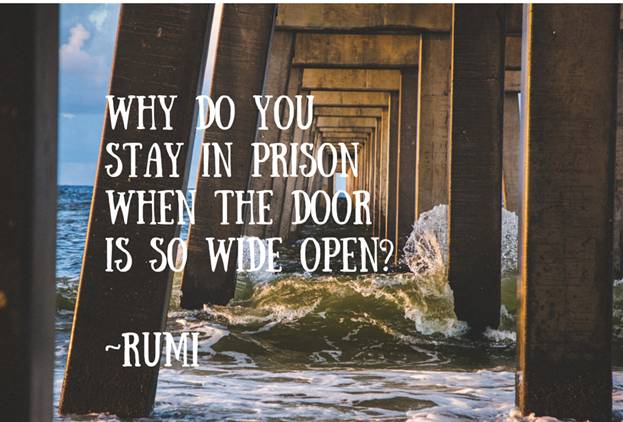
Why do you stay in prison when the door is so wide open? - Rumi

When we hear the word “addiction”, we think of bad things. Most people think of drugs and alcohol, when in fact, we are all addicted to something even if we don’t drink alcohol or take illegal drugs. If every addiction were illegal, we would all be living outside the law.

Addiction is actually an idea. It’s the thought that we cannot live without something. When we are addicted to something, it is because we think/feel/believe that the thing we are addicted to is essential to our survival and the fear of living without it is greater than the fear of the consequences of consuming it.

That was a full on concept, but please read it again:

When we are addicted to something, it does not mean we don’t understand the consequences of consuming it. It means that the fear of not consuming it is greater.

This is why it is hard to fight addiction. Our subconscious mind is stronger than our understanding of the consequences so let’s stop talking about the consequences, because they will never be the reason we stop believing anything.

Research on addictions has found that consuming something (like drugs, alcohol or sugar) is not enough to become addicted to it. We consume it when we have a void, because it allows us to manage better with that void. People who connect well with others, are in a happy relationship, are active and have a good social life are less likely to become addicted. Therefore, the way to help everybody overcome addictions is not punishing them for finding a solution that gives them (brief moments of) comfort, but helping them create the connections they need to replace their addiction.

It is important to understand that we are not only addicted to substances, but also to thoughts and ideas. Even substance addictions are based on strong beliefs. In a research on alcohol consumption, participates were given water to drink, but were told they were drinking alcohol. They behaved later on as if they were drunk, showing impaired coordination, giggling and even throwing up, just because they BELIEVED they were drinking alcohol.

Read Addictions: Are you Addicted to Your Beliefs? »

Published: October 15, 2015 by Ronit Baras
Last modified: October 15, 2015In: Personal Development, Health / Wellbeing Tags: control, alcohol, society, perception, self-fulfilling prophecy, drugs, acceptance / judgment / tolerance, fear, personal development / personal growth / personality development / self improvement, choice, feeling, failure, addiction, beliefs, emotional development

How to Control Anxiety: 35 More Tips

Every Tomorrow has two handled. We can take hold of it with the handle of anxiety or the handle of faith - Henry Ward Beecher

Anxiety is one of the most debilitating feelings we can have. We are anxious when we imagine a negative future. We do this in our head, triggering many processes in the brain that make us feel helpless and lost. Therefore, learning how to control anxiety can be very important in living a happy and healthy life.

Last week, I shared 25 tips on how to calm anxiety. Here are 35 more tips on how to control anxiety, which I hope you will find useful and easy to follow.

How to Control Anxiety Tips (26-59):

26. Tell yourself “I am safe” whenever you feel unsafe. Remember that anxiety is all in your head. Teach your head to say it whenever anxiety happens and it will do it after enough practice.

27. Set goals. Make sure to write them down. Having goals and having anxiety is the same process. We go into the future and in both of them, in our mind, but with goals, we imagine a positive future!

Read How to Control Anxiety: 35 More Tips »

Published: October 6, 2015 by Ronit Baras
Last modified: June 2, 2026In: Health / Wellbeing, Personal Development Tags: feeling, vision, alcohol, thought, love, conflict, addiction, skills, relaxation, hugs, sleep, anxiety, fun, how to, time management, fear, tips, health / wellbeing, control, personal development / personal growth / personality development / self improvement, drugs, mind, certainty, focus, change

How to Calm Anxiety: 25 Easy Tips

When we fill out thoughts with right things, the wrong ones have no room to enter - Joyce Meyer

In What is Anxiety, I explained the process of creating anxiety. Today, I want to start describing how to calm anxiety with simple, everyday tips anybody can do.

It is important to remember that Anxiety is a thinking process that we do in the present of imagining a negative future. Anxiety is the modern evolution of the “fight or flight” response. We are not certain about the future and we predict a horrible one. Most of us are very bad fortunetellers, but still most people try fortunetelling in hope that the future will somehow change from being scary to being great, if only in our mind.

It won’t, unless we change the way we go through that process, and actively, with intention, change it!

In this post and the next, I will share with you 59 tips on how to calm anxiety. Each of those tips can do the trick for short time and if you continue doing them, they will become a habit. All you need are 2-3 tips that you feel conferrable with and alternate them.

Some of the tips are very much applicable to children, so teach your kids to develop strategies to manage and calm their anxiety as soon as possible. Research shows that kids as young as 3 years old already experience anxiety, and if they live in a very anxious house, they will master anxiety very early in life.

In schools, we see many anxious kids and this can be very exhausting for the body. Think of your body in “fight or flight” mode 30 to 40 times a day. An anxious child becomes so sensitive that every word said around them becomes a lion or a snake. The road from here to developing full-blown anxiety disorder is not too long.

Read How to Calm Anxiety: 25 Easy Tips »

Published: October 1, 2015 by Ronit Baras
Last modified: October 6, 2015In: Personal Development, Health / Wellbeing Tags: questions, action, tips, focus, research, health / wellbeing, responsibility, personal development / personal growth / personality development / self improvement, success, control, feeling, emotional intelligence, mind, thought, depression, change, practical parenting / parents, anxiety, motivation, role model, hope, fear, perception, negative, positive, failure

Common Stress Causes

2 monkeys baring their teeth

In 3 Strategies to Find Your Sources of Pressure, I explained why it is important to recognize the sources of our pressure in order to eliminate stress in life and gave three strategies to find the stress causes in your life. If you have used these strategies, you are ready to use this list of common stress causes to refine your findings.

1. Lack of sleep is a major cause of stress.

2. Craving is a small source of pressure. Whenever you say to yourself, “I have to eat/do/be something”, you are putting pressure on yourself.

3. Addictions are a huge cause of pressure. Why? Because when we don’t have that thing we are addicted to, our brain goes into panic attack. Addiction can be to food, drinks (alcohol, coke…) to people, routines. If you want to know if you are addicted, try leaving without that thing for 3 weeks and see how the pressure builds up.

4. Caffeine is a big source of addiction. When our body has overdoes of Caffeine (coffee, tea, coke and chocolate) it will become edgy. If you want to recognize how much it affects you, stop any caffeine for 3 days and notice how nervous you are because your body goes through withdrawal symptoms.

Read Common Stress Causes »

Published: September 29, 2015 by Ronit Baras
Last modified: September 29, 2015In: Health / Wellbeing, Personal Development Tags: control, conflict, sleep, time management, stress / pressure, self confidence / self esteem / self worth, certainty, feeling, addiction, focus, media

3 Strategies to Find Your Sources of Pressure

Stress - it can come from many sources of pressure

Many people are very stressed, because they are under lots of pressure. If you ask them about their sources of pressure, they are not very good at pinpointing it, which only makes their life more stressful and seem to have even more pressure. Catch 22…

Stress is very debilitating in our daily life. Much research connects our health and wellbeing directly to the level of stress and our ability (or inability) to manage it. Stressed people are sick more often, have more conflicts, more relationship breakdowns and are less effective at work. These things result in earning less money, so they live in this vicious cycle that each point of pressure only feeds more pressure on other areas of life. Like I said before: Catch 22!

Pressure is related to something specific. Stress is the result of accumulated pressures. When these pressures go over a threshold, it’s too much for us to handle. We go into stress and turn our focus from control to feeling helplessness and anxiety.

In life coaching, it is very important for people to recognize that they are under pressure and that when it accumulates, it creates stress and then they are anxious about the outcome or the future. The three feelings of pressure, stress and anxiety go hand in hand in people’s reaction to events in life. I call them brothers, because they come from the same family of fear and in that family, they appear in this order. First, we have pressure, which accumulates and turns to stress, which immediately creates anxiety about the future.

In this post, I will give you 3 strategies to find your sources of pressure and eliminate stress in your life. If you follow them, in the order they are presented, you will find relief. At first, it will be a small relief, which will accumulate. The same as pressure, accumulates and turns to stress, relief accumulates and turns into control.

Read 3 Strategies to Find Your Sources of Pressure »

Published: September 24, 2015 by Ronit Baras
Last modified: September 24, 2015In: Health / Wellbeing, Personal Development Tags: fear, choice, control, change, Life Coaching, conflict, stress / pressure, focus, anxiety

How to Deal with Anxiety: What is Anxiety?

If you live in the past, you will suffer depression. If you live in the future, you will have anxiety. If you live in the present, you will be content. Lau Tzu

What is anxiety? Anxiety is one of the biggest problems of our society today. Research has found that it is one of the main reasons for sickness, relationship problems, crime and failure. People who are anxious have a bad physical reaction to thinking about the future.

Everybody feels anxiety sometimes. It is a natural reaction to what is perceived as danger – an evolution of the “fight or flight” response. While for most people, experiencing anxiety in small doses is normal and healthy, for others, feeling anxious about the future or about situations over which they have no control may cause real interference with daily living.

The problem is with the frequency of the fear and the perception of danger, when in fact there may be no real danger. When people experience mild anxiety, we call it “worrying”. When the fear takes over and blocks the person from living a normal life, we call it “Anxiety Disorder”.

Think about it this way: anxiety is when your mind goes towards a possible, horrible, bad, unpleasant future and you react to it NOW. No one is anxious when they think about getting compliments, or having a great time. We are anxious about something that MAY go wrong in the future.

Read How to Deal with Anxiety: What is Anxiety? »

Published: September 17, 2015 by Ronit Baras
Last modified: September 17, 2015In: Personal Development, Health / Wellbeing Tags: failure, questions, action, tips, research, health / wellbeing, focus, personal development / personal growth / personality development / self improvement, responsibility, control, feeling, success, mind, thought, emotional intelligence, change, practical parenting / parents, depression, motivation, anxiety, hope, role model, perception, fear, positive

  • « Go to Previous Page
  • Page 1
  • Page 2
  • Page 3
  • Page 4
  • Page 5
  • Page 6
  • Interim pages omitted …
  • Page 10
  • Go to Next Page »

Get Happiness by Email

Sign up to receive posts by email and get my free mini-course Seven Emails with Seven Secrets for Seven Weeks to boost your personal development


    Books by Ronit Baras

    • What motivates your child? Read Motivating Kids by Ronit Baras Motivating Kids From: $9.95
    • Reflections by Ronit Baras Reflections From: $5.99
    • Be Special Be Yourself for Teenagers by Ronit Baras Be Special, Be Yourself for Teenagers From: $5.99
    • In the Outback with Jasmine Banks by Ronit Baras In the Outback with Jasmine Banks From: $5.99
    • The Will by Ronit Baras The Will From: $5.99

    Be Happy in LIFE logo
    Book your private life coaching with Ronit Baras and learn how to be happy in life

    Girl speaking at student leadership programLeaders are not born. They are made. Bring this Student Leadership Program to your primary school or high school and you will create a community of empowered, inspired student leaders, parents and teachers.

    You’re Reading a Top Parenting Blog

    Feespot Parenting Blogs80 Best Family Blogs to Follow in 2026Top 50 Amazing Parenting Blogs 2017

    Related Links

    • Be Happy in LIFE – Life Coaching
    • Personal Growth Web
    • Tsoof Baras – percussionist, composer and producer
    • Noff Baras – Screen Actor & Model

    Primary Sidebar

    Your Cart

    Ready to be happy?

    Happy woman holding a cup in the snow
    Be empowered and set your spirit free!

    Engage Ronit as Your Life Coach »

    Speaker Bookings

    Ronit Baras - Practical Parenting Blogger
    Book Ronit as a Speaker for Your event »

    Join Us on Social Media

    Facebook logo Twitter logo Linkedin logo Pinterest logo RSS feed icon

    Give to Receive

    Kiva - loans that change lives

    Contact Us · Subscribe · Terms of Use / Privacy Statement · Return & Refund Policy · Sitemap

    Copyright © 2026 Be Happy in LIFE · Built and powered by Get Business Online

    Secure HTTPS

    • Home
    • Series
    • About Ronit Baras
    • Books by Ronit Baras
      ▼
      • Motivating Kids
      • Be Special, Be Yourself for Teenagers
      • Reflections
      • In the Outback with Jasmine Banks
      • The Will
      • * Your Cart
      • * Secure Checkout
    • Contact
      ▼
      • Join Us