• Skip to primary navigation
  • Skip to main content
  • Skip to primary sidebar

Family MattersPractical Parenting Blog

  • Home
  • Series
  • About Ronit Baras
  • Books by Ronit Baras
    • Motivating Kids
    • Be Special, Be Yourself for Teenagers
    • Reflections
    • In the Outback with Jasmine Banks
    • The Will
    • * Your Cart
    • * Secure Checkout
  • Contact
    • Join Us

Home » control » Page 3

Mindfulness Questions to Change Your Life for the Better

Woman holding up a button that says I'm a winner

Questions are very important on our way to mindfulness. The ancient Greek philosopher Socrates thought that questions could lead us to many discoveries. One of the most important discoveries is that questions can reveal to us what we think and lead us to a better life.

The formula is simple. When we ask good questions, we get good answers that can help us grow and evolve to a better version of ourselves.

As a life coach, I use questions a lot. I know that some questions I ask (myself or others) will lead to pain and others will empower. Questions can trigger responses like “let’s move on”, “let’s do something”, “let’s think positively”, “let’s plan”, “let’s change perspective” and “let’s appreciate”, like pressing a button.

Every thought we have also triggers a feeling, so by “pressing the button” for that thought, we can create that feeling. For example, the “good memory” button will make us happy and “bad memory” button will bring us pain and suffering.

We may not have more bad memories than good memories, but if we press the “bad memory” button more often, we will have more suffering.

Read Mindfulness Questions to Change Your Life for the Better »

Published: September 1, 2016 by Ronit Baras
Last modified: September 14, 2021In: Personal Development Tags: thought, responsibility, list, success, mindfulness, emotional intelligence, action, empowerment, control, happiness, questions, self confidence / self esteem / self worth, personal development / personal growth / personality development / self improvement, focus

The Expectations Paradox: Danger Ahead

Sign: Danger, expectations ahead!

From the minute I woke up, at the age of 16, and took control of my life, I had a good understanding of the power of expectations. At least this is what I thought for a long time. I thought that I switched from having low expectation to high expectations and believed that high expectations were the key to success in life.

I still think so, although I believe that it is important to distinguish between expectations from ourselves and expectations from others. Even more important is what we do when our expectations are not fulfilled.

Expectations can be a blessing or a curse and we can always determine what they were after the event. Subconsciously, when we succeed, we tend to consider our expectations as blessings, as a ladder that led us to victory. When we fail, we consider them false, frustrating and painful. In victories, we reward ourselves for having “motivating expectations”. In failures, we blame circumstances and/or people, and sometimes, we blame ourselves.

Expectations are a double-edged sword if we do not define them properly.

Read The Expectations Paradox: Danger Ahead »

Published: August 30, 2016 by Ronit Baras
Last modified: December 26, 2019In: Personal Development Tags: control, change, motivation, positive attitude tips, acceptance / judgment / tolerance, personal development / personal growth / personality development / self improvement, expectation, responsibility, goals / goal setting, success, emotional intelligence, empowerment

Emotional Freedom: Let Go and Be FREE!

Barbed fence with plant growing outside it

I do not know about you, but once, whenever I thought about freedom, I thought of a prison. I imagined someone trapped in a closed place against his will. It was always a physical place, with bars and darkness, and just thinking of it upset me.

When I started studying how the brain works, my perception changed. I learned that there is another prison – a very secure place that is the hardest to escape. Most of us live in the prison of our own mind, in which we are limited by our way of thinking.

I remember the time that I experienced the loss of my child. I could feel how quickly I was building my own prison and how each thought was adding one more bar and one more lock around me. The hardest realization was that only I could set myself free.

No one in their normal mind wants to be trapped inside their mind. Yet, in some way or another, we all are. This is because we are not in our normal mind. Yes, me too. Do not take this too hard, but Buddhists think we are all delusional, trapped in the prison of our own ego.

Think about it: imprisonment is the absence of freedom. We only desire freedom when we feel that we do not have it. If you feel free, why would you search for freedom? This comparison between what we have and what we lack, followed by the bad feeling we have about it, is a prison in itself.

Read Emotional Freedom: Let Go and Be FREE! »

Published: August 11, 2016 by Ronit Baras
Last modified: December 26, 2019In: Personal Development Tags: happiness, perception, positive, responsibility, personal development / personal growth / personality development / self improvement, emotional intelligence, freedom, depression, expectation, how to, negative, beliefs, control, change

Reasons: The Search for Cause and Effect

A row of dominos with a hand in the middle stopping them from continuing to fall

I often hear that finding the reasons for things we do is the way to have a happy life. There are many public claims that understanding why we do things cures bad decisions and is the way to contentment.

However, it is important to distinguish between the search for a reason and finding a reason. Searching for a reason is a continuous state of limbo, based on the belief there is one true reason for something. Finding a reason is just an illusion that the reason we found is the one true reason.

There is a big challenge in searching for the one reason, mainly because most of our decision making (in fact, more than 90%) is done by our subconscious mind, which means we are not aware of it. We only know of 10% of it.

Our conscious mind can process a limited number of thoughts and memories, so it is unlikely to lead us to the “right” reason, or right decision. At the same time, our subconscious mind can process millions of thoughts and memories in a split second. We can never hope to be aware of everything that goes on “down there”.

So in humans, the concept of cause and effect is not that simple. There is no single cause that will lead to the same effect.

Read Reasons: The Search for Cause and Effect »

Published: July 28, 2016 by Ronit Baras
Last modified: December 26, 2019In: Personal Development Tags: assumptions, emotional intelligence, choice, control, happiness, interpretation, decision making, acceptance / judgment / tolerance, behavior / discipline, personal development / personal growth / personality development / self improvement

Addiction in the Family

Young woman smoking

Addiction a dependency on an object, a substance or an activity. As hard as it is to admit, we are all addicted in some way or another. If you want to know if you are addicted do something, take it out of your life for a week and watch your reaction.

People can be addicted to food, phone, TV, a person (like their spouse), work, coffee, alcohol, cigarettes, glue, sex, medication, gambling, drugs and more. I had a friend who was addicted to pain killers. She took them as if she was eating candy, and it became obvious she had an addiction because she could not cope without them and needed more and more of them over time.

It is very important to remember that every addiction we develop is an attempt to fill an emotional and/or physical “hole”. We want it to give us the feeling we are missing without it. This is as true when we talk about drugs as it is when we talk about food.

Read Addiction in the Family »

Published: July 6, 2016 by Ronit Baras
Last modified: March 19, 2021In: Health / Wellbeing, Family Matters Tags: responsibility, addiction, control, change, alcohol, family matters, needs, health / wellbeing, personal development / personal growth / personality development / self improvement, drugs, feeling

Stop Looking for Certainty and Have Faith

Country road going toward a rainbow

Certainty is a great asset in life. We all seek certainty. Some seek it inside themselves and others seek it externally. Some find it in faith, others in routine. Certainty gives us lots of confidence in the world around us. We use it to mourn the fact we were not born fortunetellers. We do not like the idea that we cannot control the future and this shakes our confidence. If we want confidence, we must lean on some things to will stay stable in our life.

I find certainty an overrated concept. In marriage, for example, people seek signs of certainty that they have chosen the right match.

One of my clients was very upset her boyfriend asked her to sign a prenuptial agreement and did not want to marry. I specifically say, “did not want to marry”, because she said that he did not want to marry her, but he did not want to marry anyone else either. He just did not believe in the institute of marriage.

When we examined this desire for certainty, we realized that if she married him in a flashy, white dress wedding, she had a greater chance of divorcing him. The more we discussed it, the more she realized that the intentions, the desire to work on the relationship and the commitment do not change if they have the same bank account, a white wedding or an expensive honeymoon. All couples start with the right intention and lucky us, they cannot see into the future.

Read Stop Looking for Certainty and Have Faith »

Published: June 16, 2016 by Ronit Baras
Last modified: April 18, 2021In: Personal Development Tags: change, happiness, relationships / marriage, hope, attitude, self confidence / self esteem / self worth, personal development / personal growth / personality development / self improvement, certainty, emotional intelligence, expectation, beliefs, control

How to Overcome Hard Times with Mindfulness

Surviving Tough Times

Hard times are part of life. Even the happiest and most successful people go through hard times. When they describe their successes, they typically share the hard times and how they got over them. When you are in the middle of a difficult period, it feels all consuming, like end of the world. It feels… hard!

Unfortunately, negative thinking can make the hard times feel even harder. Think of it as driving a car. Good times are like driving in a flow, when all the traffic lights are green and it feels like you are cruising. Hard times feel like there is a stop sign or red light at every intersection, and driving seems to take forever, because the cars in front of you cannot move forward, while you are running late for an important meeting.

When your thinking is negative, it feels like you are driving… backwards.

Read How to Overcome Hard Times with Mindfulness »

Published: June 7, 2016 by Ronit Baras
Last modified: June 7, 2016In: Personal Development Tags: self-talk, questions, self confidence / self esteem / self worth, personal development / personal growth / personality development / self improvement, feeling, frustration, success, mindfulness, emotional intelligence, depression, how to, control

Distorted Definition of Depression Increases Depression

Young man walking head down in a wide fied

Depression is a big problem in our society. People think that nowadays we have more depression, when in fact we do not. What we have is a distorted definition of happiness and depression.

Here are some myths about happiness and depression that make people feel even more depressed.

Myth 1: Happy people are happy at all the time

When I go over the happiness scale with my clients, many of them think that they are supposed to be happy all the time. I can understand how people with this distorted definition of happiness can feel depressed. Some of them say that on a scale of 1-100, a happy person feels 95 happy or even 100. Since 100 is a state of total excitement and bliss, we cannot experience the excitement if we are high all the time.

Human beings’ nervous system notices differences. Feeling just a little bit happier than before works just as well when you go from 32 to 35 as when you go from 62 to 65. So every day, focus on being just a little happier than you were yesterday.

Read Distorted Definition of Depression Increases Depression »

Published: April 12, 2016 by Ronit Baras
Last modified: April 12, 2016In: Personal Development, Health / Wellbeing Tags: attitude, health / wellbeing, personal development / personal growth / personality development / self improvement, emotions, feeling, focus, depression, control, change, happiness

How to Get Rid of Procrastination

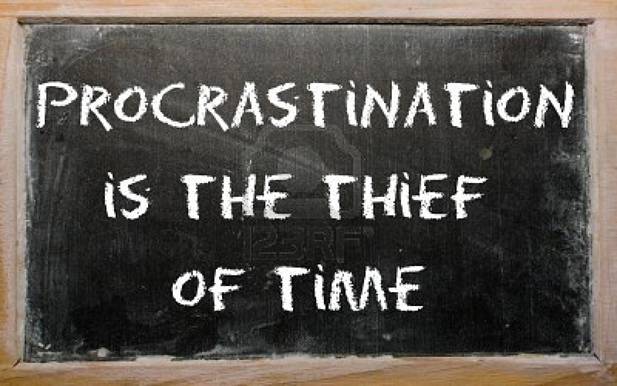
Procrastination is the thief of time written on a blackboard

Procrastination is a big problem for anyone who would like to achieve anything. Although from the outside it looks like it is not a problem to do nothing at all, it is not a state of doing nothing from the inside. Inside, there is a fear that right now, doing nothing seems better than anything we can think of doing.

It is important not to confuse a state of bliss and contentment with procrastination. Bliss is doing nothing and enjoying it. Procrastination is doing nothing from fear of the outcome of anything we do.

Procrastination and anxiety are twins and anxiety is the elder. Anxiety is a fear of some imaginary bad future and procrastination is our coping mechanism with anxiety (not a very effective strategy, but a very common one).

When we use it too often, we reach the “whatever” stage, when we “pretend” we do not care what the outcome will be. We always care! Unless you are a Buddhist in your heart and soul (which is a good aspiration), you care about the outcome. You can say you do not care, but you cannot cheat your own subconscious mind into believing you are the Dalai Lama and will be happy with whatever happens.

When our mind thinks we are in danger (because of something someone said or because of what someone might say), it has three choices: fight, flight or freeze. Procrastination is equivalent to the “flight” response – running away at the sight of danger.

Read How to Get Rid of Procrastination »

Published: April 7, 2016 by Ronit Baras
Last modified: April 7, 2016In: Personal Development Tags: personal development / personal growth / personality development / self improvement, focus, feeling, emotional intelligence, procrastination, anxiety, fear, choice, action, control, change, happiness, motivation

How to Switch Your Parenting from Preaching to Teaching

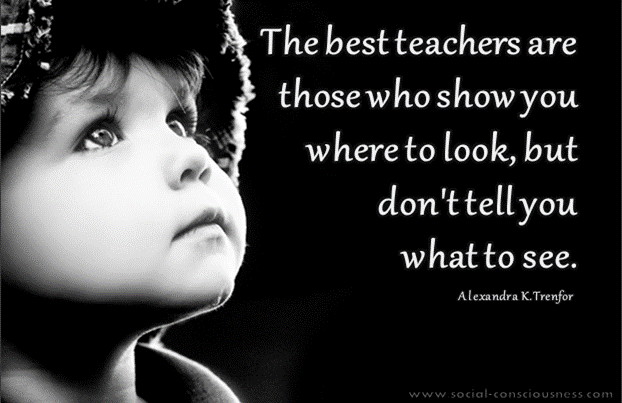
The best teachers are those who show you where to look, but don't tell you what to see - Alexander K. Trenfor

In Parenting is Teaching, not Preaching, I explained why kids resent parents who take too long to explain things and why a relationship based on lecturing your kids is not healthy and makes the kids just not listen to you.

Today, I share five tips that will make the communication and cooperation at home better for you and show you how to switch your parenting from preaching to teaching.

1. No Pink Elephants

Parents are used to telling their kids what not to do. The words “don’t”, “stop” and “no” are very common in the parenting vocabulary. Unfortunately, using them only makes the child do more of what you are trying to stop. Read Beware of Pink Elephants for more.

Rather than telling your kids what not to do, tell them what you want them to do and notice how their behavior changes dramatically.

Read How to Switch Your Parenting from Preaching to Teaching »

Published: March 22, 2016 by Ronit Baras
Last modified: October 2, 2023In: Parenting Tags: change, values, anger, emotional intelligence, sarcasm, how to, listening, role model, tips, choice, acceptance / judgment / tolerance, trust, behavior / discipline, beliefs, education / learning, control, expectation, rules, emotional development, communication, generation gap, practical parenting / parents, abuse

  • « Go to Previous Page
  • Page 1
  • Page 2
  • Page 3
  • Page 4
  • Page 5
  • Interim pages omitted …
  • Page 10
  • Go to Next Page »

Get Happiness by Email

Sign up to receive posts by email and get my free mini-course Seven Emails with Seven Secrets for Seven Weeks to boost your personal development


    Books by Ronit Baras

    • What motivates your child? Read Motivating Kids by Ronit Baras Motivating Kids From: $9.95
    • Reflections by Ronit Baras Reflections From: $5.99
    • Be Special Be Yourself for Teenagers by Ronit Baras Be Special, Be Yourself for Teenagers From: $5.99
    • In the Outback with Jasmine Banks by Ronit Baras In the Outback with Jasmine Banks From: $5.99
    • The Will by Ronit Baras The Will From: $5.99

    Be Happy in LIFE logo
    Book your private life coaching with Ronit Baras and learn how to be happy in life

    Girl speaking at student leadership programLeaders are not born. They are made. Bring this Student Leadership Program to your primary school or high school and you will create a community of empowered, inspired student leaders, parents and teachers.

    You’re Reading a Top Parenting Blog

    Feespot Parenting Blogs
    Top 50 Family Blog Award Top 50 Amazing Parenting Blogs 2017

    Related Links

    • Be Happy in LIFE – Life Coaching
    • Personal Growth Web
    • Tsoof Baras – percussionist, composer and producer
    • Noff Baras – Screen Actor & Model

    Primary Sidebar

    Your Cart

    Ready to be happy?

    Happy woman holding a cup in the snow
    Be empowered and set your spirit free!

    Engage Ronit as Your Life Coach »

    Speaker Bookings

    Ronit Baras - Practical Parenting Blogger
    Book Ronit as a Speaker for Your event »

    Join Us on Social Media

    Facebook logo Twitter logo Linkedin logo Pinterest logo RSS feed icon

    Give to Receive

    Kiva - loans that change lives

    Contact Us · Subscribe · Terms of Use / Privacy Statement · Return & Refund Policy · Sitemap

    Copyright © 2026 Be Happy in LIFE · Built and powered by Get Business Online

    Secure HTTPS

    • Home
    • Series
    • About Ronit Baras
    • Books by Ronit Baras
      ▼
      • Motivating Kids
      • Be Special, Be Yourself for Teenagers
      • Reflections
      • In the Outback with Jasmine Banks
      • The Will
      • * Your Cart
      • * Secure Checkout
    • Contact
      ▼
      • Join Us