A Fresh New Year Reflection on Healing, Hope, and Light
There’s something magical about the New Year. Even if nothing changes overnight, the calendar flips and suddenly we feel a tiny spark — a chance to start again.
But if the last few years have taught me anything, it’s this:
Life doesn’t get lighter because we avoid the darkness. It gets lighter when we learn to walk through it with open eyes.
The last several years were a bit dark for me. This New Year, I want to explore the idea of embracing darkness, not as something scary or unwanted, but as something deeply useful — even beautiful — in our emotional, physical, and family life.
Darkness isn’t the opposite of light. It’s the contrast that makes light visible.
Ronit Baras
We spend so much energy trying to avoid pain, sadness, fear, or discomfort — especially as parents.
But what if darkness isn’t a punishment? What if darkness is your body and soul tapping you gently on the shoulder saying, “Pay attention. Something needs your love.”
Embracing Darkness: The Message Behind the Feeling
I grew up terrified of anything that looked like discomfort. My parents were the same.
A rash? Run to the doctor.
A cough? Panic.
A fever? Total meltdown.

I think my parents were very frightened parents. With 5 kids, working hard and focusing mainly on survival. They didn’t really make the connection between body and mind. How we felt, how they felt, was not at all on their radar.
Back then, any discomfort was pushed to the side and if the body “screamed” too much for attention in a form of illness, doctors were the solutions. Take a pill and push the emotion to the side. We spent so many hours at the body’s doctor and nothing at all at the soul doctor.
I don’t blame my parents, I think they did what they could. They were probably treated the same way.
I was a very sick girl and have seen doctors all my childhood. It was at the age of 12 when I said no more medications, no more doctors and I started listening to my body.
Over the last 50 years, when people asked me what triggered it, I can’t 100% pinpoint the moment it happened. I was 12 and I started dreaming stories asking me to “write” them. I called them “imaginations” but maybe it was my body talking to me.
Don’t get me wrong, my life back then sucked big time. I had no friends, I was a troublemaker at school and a failing student, I was sick, home was a jungle… All aspects of my life were very dark. Through this darkness, resisting an external “medication” to fix me, I learned that my body, my emotions are wired to communicate with us.
Darkness isn’t danger. Darkness is data.
Families grow stronger not by avoiding darkness, but by walking through it together.
Ronit Baras
The Body Never Lies
I was 15 years old when I went to the local library to get a book. I browsed the shelves a book caught my eyes. It was a book full of research about the brain. The spine was not colourful; the name was nothing special. I took it home and read hundreds of research papers about how our brain works. This book changed the course of my life.
I knew I picked it because my body was talking to me otherwise there is no logical explanation to why I picked the book.
In that book, I learned first time about the connection between the body and mind. Later on, I learned that the body constantly speaks, we just need to listen.
In 1991, researcher Candace Pert explored how emotions show up chemically in the body. She wanted to know if feelings were “real” enough to create physical reactions. She studied neuropeptides — the body’s chemical messengers — and found that every emotion we feel sends a message through our cells.
Her conclusion?
The body speaks long before the mind understands.
I felt it the second I picked that book in the local library. This single idea changes everything about embracing darkness.
The Day Darkness Became a Teacher
When I was 18, my younger sister gave me Louise Hay book “How to Heal Yourself”. In that book, Louise Hay describes every illness as a message from the body. She didn’t invent the idea between body and mind, she just explained beautifully an ancient wisdom.
It was an eye-opening book. From that moment, every time I experienced physical discomfort or felt in dark tunnel, I asked myself “What is my body trying to tell me?”
I stopped fighting the darkness. I started listening to it.
Darkness is often the body’s way of whispering a truth we’ve been too busy to hear.
Ronit Baras
The Emotional Side of Darkness

Why we must feel it, not fix it
Somewhere along the path of adulthood, we were taught that emotional pain is a sign of failure. We learned that if we’re anxious, sad, lonely, resentful, or overwhelmed, we need to hide it… quickly.
But emotions are just messengers, the same way fever is. A fever doesn’t mean your body has failed — it means it’s working.
Emotional darkness is exactly the same.
We need to feel our emotions on our way to healing: In 2007, psychologist Leslie Greenberg studied hundreds of people processing emotional pain. He discovered something fascinating:
People who allowed themselves to fully feel difficult emotions — without rushing to fix them — recovered faster and developed greater emotional strength.
His conclusion?
Emotion is not the problem. Avoidance is.
This is where embracing darkness becomes not just a metaphor, but a roadmap.
Avoiding pain is what makes sure we live it over and over again. It leaves us in a state of flight mode, forever. We do it so much that eventually, we run from ourselves.
Darkness Helps Us Reset
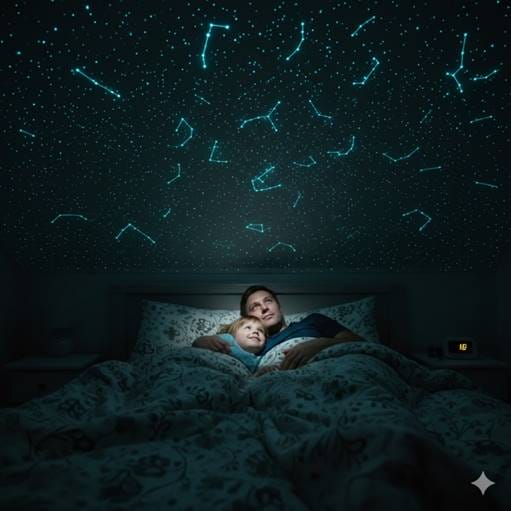
When my kids were little, we had glow-in-the-dark stars all over the ceiling. (now they are not home, we still have them, even in my bedroom)
Every night, we’d turn off the lights and wait…
Five seconds. Ten seconds. Then — slowly — the stars would appear.
But here’s the thing: You can’t see stars when the light is on. You only see them in the dark.
And life is exactly like that. “Some truths only reveal themselves when everything else goes quiet.”
Dark moments are not interruptions. They are invitations.
Why Embracing Darkness Helps Families Grow
The new year and family gathering brings plenty of stress to most people. All challenging emotions emerge and everyone is anxious about meeting each other.
When families fight, feel stressed, or hit rough patches, we often panic — as if something has gone terribly wrong. But darkness inside a family isn’t a sign that the family is broken.
Darkness usually means something needs attention — compassion, boundaries, rest, or healing.
Just like night allows the earth to reset, emotional darkness allows families to breathe, recalibrate, and reconnect.
It sounds counterintuitive. But holiday season is an opportunity to heal. Instead of fighting the darkness, we need to learn to embrace darkness so we can finally see the light.
I have many clients asking me about how to manage the family conflict and I think that mindfulness is a good tool. Just pausing before reacting. Just practicing conscious breathing without going straight away into the “primitive” state of fight, flight, freeze can be so powerful, and I didn’t even invent it. Again, old religions and traditions advocated for it in ancient times.
In 2010, Mark Williams studied families practicing mindfulness. He found that parents who paused to notice their emotional state — instead of reacting — significantly reduced conflict and increased emotional resilience in the home.
His conclusion?
Pausing creates peace.
This is true for parents, true for relationships with our own parents, siblings, friends, colleges and also true in the relationship with ourselves.
And embracing darkness is simply learning to pause long enough to hear what’s really going on.
We Need Darkness to Appreciate Light

I know this sounds like something you’d see on a fridge magnet — and funny enough, that’s exactly where I got mine.
Years ago, I went with Gal (my husband) to a mind body festival, and someone handed me a small card as a gift
It said:
“It’s a dark world. Be the light.”
I stuck it on my fridge, and it’s been there ever since. I see it every day as a reminder.
The message wasn’t saying the world is hopeless. it was saying:
Yes, you will meet darkness. That’s inevitable. But you can choose to bring light with you to make it brighter.
This is the heart of embracing darkness. Light doesn’t eliminate the dark. It transforms it.
I do believe each of us has a role in this life to do exactly that. Bring light into this world not by fighting darkness but embracing it so we can cross over.
Pain is not the enemy. It is the doorway we must walk through to reach the next version of ourselves.
Ronit Baras
How Parents Can Practice Embracing Darkness
When I think of our rule as bearers of light, I believe that parenting is the most wonderful, amazing light holder job in the world. My children know (and so are my friends and clients) that my purpose in this life was to be a mother. You can read this blog from top to bottom and learn from each post how seriously I think that.
Children are born into a very scary world where they are helpless and dependent, and everything comes with uncertainty. There so little they can control. For them life comes from darkness. Our job is to light the way for them.
With so much love and care for them, we, parents rush to fix their problems, remove the fear and pain and with that, we teach them to keep fearing challenges, disappointments, pain.
We detach them from their own body and instead of teaching them to listen to the messages, we rob them of opportunities to practice those listening skills. Instead of teaching them to embrace darkness, we teach them to fear it, avoid it at all costs. Sadly, out of so much love we cause them so much pain.
We, as parents, need to live by example. Instead of fearing pain, we can model how to listen to it. Walk through it, towards the better version of ourselves.

Here are small ways to welcome the messages before rushing to fix them:
1. Name the Darkness
Whether it’s stress, disappointment, fear, or anger — name it.
“Ah. Right now, I’m feeling overwhelmed.” Naming it reduces the intensity. We call it “name it to tame it”.
2. Let it talk
Darkness is not a threat — it’s information.
Ask yourself: What is this feeling trying to tell me?
Ask it enough time and remember, it never tries to tell you off. It is always trying to protect you.
3. Don’t rush to erase
Sit with it.
Not forever — just long enough to understand its message. Much like when we sit in darkness, our eyes get used to it and we start noticing shapes, darkness works the same. Sit there long enough and you’ll start noticing things.
Take a deep breath. Notice you are still alive. You are not dying or going to die. Pay attention to where you hold the feeling in your body. Be an observer. Notice it without judgment. Keep breathing.
4. Look for the star in the dark
Every difficult moment hides a gift — a tiny star. It is a lesson, a reminder, a direction.
feelings are just communication messages. All of them are opportunities in disguise. In 10 years, 20, or even earlier, you’ll use this dark spot to share a growth point in your life.
5. Share the experience as a family
Talking about emotions teaches kids that darkness is safe to explore and not something to fear.
I make a point to share with my children some stories from my life, my childhood, my teenage years and adulthood.
I share the dark and the light and how I felt about them back then and how I feel about them now.
When I share them, it is only because I crossed over. They are all inspiration for courage and growth.
I encourage all my clients to do the same.
Share your stories with your children. Stories of heartache and victories, stories of pain and joy, Stories of darkness and light because when you share your dark moments you give them permission to share theirs. You teach them it is part of life. You teach them to embrace darkness and remember there is always light on the other side.
A New Year Lesson: Light Always Returns

If you’ve ever watched a sunrise, you know something beautiful:
The dark never fights the light. It simply moves aside when light appears.
Most of the struggles we feel come from resisting the darkness, not from the darkness itself.
So, when we stop running, something amazing happens — the darkness becomes softer, lighter, easier to navigate.
This is my wish for you and your family this year: Not a year free from darkness, but a year where you are unafraid of it.
When you stop fearing the dark, you discover the light you carry inside.
Ronit Baras
In This New Year, Be the Light
Every year brings its own mix of storms and sunshine. But you get to decide how you walk through it.
Be kind.
Be gentle.
Notice the small joys.
Celebrate the small wins.
Speak kindly to yourself and others.
Light candles.
Find the stars.
Let darkness teach you — not terrify you.
This New Year, may you find light in unexpected places and courage in the quiet corners of your heart.
And may embracing darkness help your family grow stronger, softer, wiser, and more connected than ever.
Happy New Year!
With love,
Ronit