• Skip to primary navigation
  • Skip to main content
  • Skip to primary sidebar

Family MattersPractical Parenting Blog

  • Home
  • Series
  • About Ronit Baras
  • Books by Ronit Baras
    • Motivating Kids
    • Be Special, Be Yourself for Teenagers
    • Reflections
    • In the Outback with Jasmine Banks
    • The Will
    • * Your Cart
    • * Secure Checkout
  • Contact
    • Join Us

Home » values » Page 4

I’m OK, You’re OK Parenting: “I’m OK” Beliefs

3 children resting
This entry is part 7 of 7 in the series I'm OK - You're OK Parenting

This is the last installment in the “I’m OK, You’re OK Parenting” series. To wrap up, I want to share some beliefs that have helped me as a parent, and also many of my clients, to adopt an I’m OK, You’re OK parenting mentality.

The best way to overcome guilt and shame is to adopt beliefs that strengthen our view of ourselves as OK (I’m OK) and of others as OK (You’re OK) – The I’m OK, You’re OK mindset. There are many ways to identify whether you are in another frame of mind. For example, If you are upset, or disappointed, if you lecture your kids, or want them to do something they do not want to do, if you are threatening them, punishing them, shouting at them or if you want to teach them a lesson, if you shame them, use name calling, or ridicule them, and if you think life needs to go your way “or else”, this generally means you are not in the I’m OK, You’re OK mode. This means your child is also learning this mindset and will most likely not be in the I’m OK, You’re OK mode either.

Read I’m OK, You’re OK Parenting: “I’m OK” Beliefs »

Published: October 1, 2013 by Ronit Baras
Last modified: December 25, 2019In: Personal Development, Parenting Tags: emotional development, success, perception, practical parenting / parents, emotional intelligence, compassion, role model, needs, choice, positive, trust, kids / children, failure, acceptance / judgment / tolerance, language, self confidence / self esteem / self worth, beliefs, personal development / personal growth / personality development / self improvement, gratitude, identity, responsibility, happiness, guilt, values, Life Coaching

Choice Theory: Happy Relationships

Heart-shaped maze
This entry is part 2 of 6 in the series Choice Theory

The choice theory, founded by William Glasser, suggests that all our actions are chosen and driven by the five basic needs: survival, love and belonging, power, freedom, and fun.

In relationships, our needNeed for love and belonging for love and belonging is the most important one. Based on Glasser, satisfying this specific need will guarantee our ability to fulfill all other needs. The source of all problems in the world, according to the choice theory, is disconnection. Behavior problems, mental illnesses, violence, abuse, crime, school problems, marriage breakdown, relationship challenges, and depression are all a result of our inability to connect or feel love and have a sense of belonging.

Our relationship with those we care about and care for us depends on our caring ability. Glasser suggested that there are 7 deadly habits that needed to be replaced with 7 caring habits.

Read Choice Theory: Happy Relationships »

Published: September 26, 2013 by Ronit Baras
Last modified: December 25, 2019In: Personal Development, Relationships / Marriage Tags: acceptance / judgment / tolerance, language, self confidence / self esteem / self worth, beliefs, personal development / personal growth / personality development / self improvement, identity, gratitude, happiness, guilt, responsibility, Life Coaching, emotional development, values, relationships / marriage, success, perception, emotional intelligence, compassion, choice, needs, trust, positive, failure

Choice Theory: Be Happy in Life

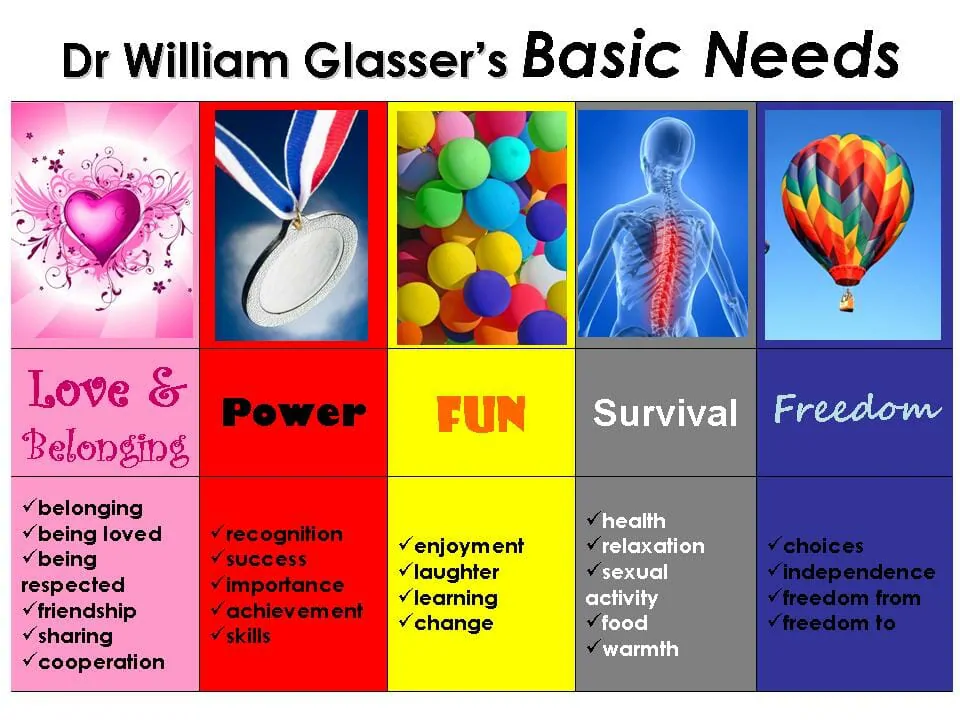
Dr. William Glasser’s 5 Basic Needs
This entry is part 1 of 6 in the series Choice Theory

Dr. William Glasser is an American psychiatrist who developed the Reality Theory, which later on became known as the Choice Theory. In the seventies, Glasser’s work was not highly accepted by his colleagues.

While others thought that human behavior is affected by external sources, Glasser believed in personal choice, personal responsibility, and personal transformation. While others considered certain behaviors as mental disorders and prescribed medication for these, Glasser believed in the education and empowerment of his clients to change their choices. He applied his theories on education, management, and marriage.

The Choice Theory states that a person’s behavior is inspired by what that person wants or needs at that particular time, not an outside stimulus. Glasser thought all living creatures control their behavior to fulfill their need for satisfaction in one or more of these five areas:

Read Choice Theory: Be Happy in Life »

Published: September 19, 2013 by Ronit Baras
Last modified: November 28, 2022In: Life Coaching, Personal Development Tags: identity, guilt, gratitude, happiness, emotional development, responsibility, Life Coaching, practical parenting / parents, values, perception, success, compassion, emotional intelligence, needs, choice, positive, trust, acceptance / judgment / tolerance, failure, self confidence / self esteem / self worth, language, personal development / personal growth / personality development / self improvement, beliefs

I’m OK, You’re OK Parenting: Guilt

Shadow of parent point down at sitting child
This entry is part 3 of 7 in the series I'm OK - You're OK Parenting

Guilt and shame are siblings in the family of feelings. Despite certain similarities, there is a clear distinction between them. Guilt is feeling bad about something you have done, while shame is feeling bad about who you are or a part of you. One is about behavior and can be changed. The other is related to your sense of identity and therefore harder to change.

In the ever evolving phases of parenting styles, the shift from physical punishment to shame was intended to use guilt more effectively than before, in the hope that it would teach children how to behave when their parents were not there. A bit like a GPS. Parents decided “guilt” was better than smacking because it worked even when mom and dad were not there. The purpose was still to monitor and control emotionally, but with good intentions; to create lasting discipline.

Read I’m OK, You’re OK Parenting: Guilt »

Published: September 5, 2013 by Ronit Baras
Last modified: June 5, 2019In: Parenting Tags: failure, practical parenting / parents, action, beliefs, identity, positive, values, cultural, emotional intelligence, acceptance / judgment / tolerance, depression, behavior / discipline, anxiety, how to, guilt, fear, emotional development

What Are You Worth?

Handful of money

Many of the people who come to the Be Happy in LIFE coaching program reveal that they have issues with their self-worth. They do not always appreciate themselves and what they have. It is up to me to shift their focus towards the great things they have in their lives or how capable they are.

Self-worth can be damaged when we face difficulties and “failures”. I put failures in quotation marks because I think every “failure” is an opportunity in disguise. I did not always think like this so I understand how hard it is for my clients to recognize it. When things do not work out the way we expect them to, they create doubt. Doubt is very debilitating.

Read What Are You Worth? »

Published: July 23, 2013 by Ronit Baras
Last modified: December 25, 2019In: Life Coaching, Personal Development Tags: values, emotional intelligence, failure, Life Coaching, positive attitude tips, acceptance / judgment / tolerance, self confidence / self esteem / self worth, personal development / personal growth / personality development / self improvement

Know Your Partner: Parenting

Happy Family
This entry is part 8 of 8 in the series Know Your Partner

If you are familiar with this blog, you know that parenting is one of our key topics and that is why it is important to discuss parenting when you get to know your partner. This is the final installment of Know Your Partner, a series of posts to help you get to know your partner, and today’s post is about parenting.

You may find that you need to ask many questions that are not cover here. Also, keep in mind that people’s opinions about parenthood are often not fully formed yet. If you have never been a parent, you don’t know what you don’t know.

In this case, parenting is like a discovery zone – you pave the path while walking it. Focus instead on attitudes you think will benefit you or may become an obstacle in your relationships. If attitudes are an obstacle, do not worry. It is possible to change them. It is just good to know what they are at the start, so you can make an educated decision about whether to go into this relationship or not.

Read Know Your Partner: Parenting »

Published: June 25, 2013 by Ronit Baras
Last modified: December 25, 2019In: Parenting Tags: communication, lifestyle, love, family matters, values, decision making, emotional intelligence, positive attitude tips, choice, attitude, beliefs, questions, father, kids / children, happiness, emotions, relationships / marriage, family planning, practical parenting / parents, conflict

My Anti -TV campaign

As an advocate of emotional intelligence, I object to kids watching TV. Everything I try to give them, the TV is destroying. I think bringing a TV home is like bringing the opposition into your living room, to tell your kids that you, the parent is wrong. Why would you do that?

When Eden was young and we were a young couple, we did not have a TV at home. My grandmother, who wanted to buy a new TV, suggested we take hers and we refused. We worked and when we were home, there were better things to do with our time than watch TV. Some family members and friends thought we were nuts and that we were not preparing our daughter to live in the real world. 24 years later, I can tell you, she is prepared for the real world, maybe even better than many other kids her age.

A month ago, Brisbane experienced a huge storm and trees were up rooted not far from us (it was really scary). Many houses experienced major damage and were without electricity for days (Many difficulties pop up when you do not have electricity for 3 days. We depend on electricity so much). We were the lucky ones. The only thing that happened to us was that our 20 year old 25 inch TV shorted (even though it had a surge protector). Tsoof and Gal were very happy because they have been wanting to buy a new TV for a year. Eden and I were not very happy. We ended up buying a huge TV with the promise to only watch videos and minimize watching TV.

Read My Anti -TV campaign »

Published: March 19, 2013 by Ronit Baras
Last modified: November 9, 2021In: Parenting Tags: values, technology, emotional intelligence, decision making, negative, kids / children, computer, teens / teenagers, mother, parenting teens, father, acceptance / judgment / tolerance, mom, movies, dad, practical parenting / parents, television, home / house, tv, responsibility, family matters

Consistency is Key to Good Parenting

In my last post, I Learned it From the Best we talked about how influential parenting is for a child’s future. In the long term, some things parents do are positive and some are negative. But which ones are positive? Which parenting styles are good for your children? In this post, I want to go into detail about the importance of consistency – the value of giving consistent rewards, punishments, attention and praise.

In early childhood, parenting in general gives children a toolkit of skills and beliefs they can take with them. It helps them deal with the challenges that life puts in their paths. If parents give their child positive, useful tools, then they are well equipped for the future. Things like praise and attention give confidence. On the other hand, parents who give their children bad habits and poor attitudes are setting them up for struggle. Addictive behaviors and poor eating habits are examples of unhelpful tools.

Read Consistency is Key to Good Parenting »

Published: March 7, 2013 by Eden Baras
Last modified: March 19, 2021In: Parenting Tags: budget, beliefs, academic performance, divorce, positive attitude tips, separation, positive, mother, attitude, father, stress / pressure, values, mom, behavior / discipline, money, dad, certainty, anxiety, relationships / marriage, practical parenting / parents, how to, conflict, role model, family matters, negative

Kids Cheating with Mobile Phones: Who is to Blame?

Schools struggle a lot with the increased use of mobile phones by children. Many new regulations are in place to stop children from bringing mobile phone to school. At a primary school level, some schools ask the students to deposit their mobile phones at the office. In high schools, the phone devices are part of everyday life and a regular item in each class. In the past, teachers had to deal with the concentration and focus of the children. Now, they need to fight the attraction of the mobile phones as well!

With the introduction of mobile phones, one new problem that teachers to deal with is cheating on tests. In the past, students had to think of very sophisticated ways of writing cheat shits on paper, on their hand, the back of the ruler or the calculator. Kids today have a very handy way to keep the information and they use it well.

A survey conducted by a media sources with some common sense discovered that a third of teens with mobiles admitted to storing information on their phone, using it in an exam or texting their friends the answers while their friends are in the exam.

Read Kids Cheating with Mobile Phones: Who is to Blame? »

Published: February 28, 2013 by Ronit Baras
Last modified: June 7, 2023In: Kids / Children, Education / Learning Tags: family matters, creative / creativity, assessment, education / learning, fear, technology, practical parenting / parents, choice, k-12 education, teaching / teachers, internet, academic performance, digital, attitude, research, kids / children, change, teens / teenagers, memory, parenting teens, school, intelligence, behavior / discipline, values, anger, health / wellbeing, art

Make a List: Inspiring People

This entry is part 34 of 49 in the series Make a List

Inspiration is contagious. It is the act of giving without the intention of giving that touches people at their core and helps them move forward towards being better, stronger people.

When I take stock of my life, my behavior, my attitude, beliefs and feelings, I often discover that other people have contributed greatly to who I am. When people have contributed in a bad way, I say that because of them or something that happened with them, I got stuck in a bad place in my life. In a sense, I am blaming them for being part of my life. When they have contributed in a good way, I say they have inspired me or encouraged me to reach where I am now. I am grateful and happy that they have been part of my journey.

It is not by accident that when people see a psychologist to figure out something that bothers them in life, they end up talking about their parents or siblings. These people are major contributors to who we are. Regardless of our relationship with our own families in the present, our parents, brothers and sisters influenced us mainly because of the many years we spend together, often through critical times during our life (read Divorcing Your Parents and people’s comments and you will find out how many parents have failed to inspire their children who are now adults).

My mom and dad influenced me in different ways, because they were totally different people. As a kid, I had lots of criticism towards them. When I started my personal growth experience at the age of 16 (lucky me, I was young), I changed the question from “How did they screw up my life?” to “How did each of them inspire me?” It is amazing how many great answers I have received.

Read Make a List: Inspiring People »

Published: August 20, 2012 by Ronit Baras
Last modified: March 18, 2021In: Personal Development Tags: motivation, relationships / marriage, values, positive, inspiration, emotional intelligence, self confidence / self esteem / self worth, how to, personal development / personal growth / personality development / self improvement, negative, practical parenting / parents, beliefs, identity, change, happiness

  • « Go to Previous Page
  • Page 1
  • Page 2
  • Page 3
  • Page 4
  • Page 5
  • Page 6
  • Interim pages omitted …
  • Page 11
  • Go to Next Page »

Get Happiness by Email

Sign up to receive posts by email and get my free mini-course Seven Emails with Seven Secrets for Seven Weeks to boost your personal development


    Join Us on Social Media

    Facebook logo Twitter logo Linkedin logo Pinterest logo RSS feed icon

    Books by Ronit Baras

    • What motivates your child? Read Motivating Kids by Ronit Baras Motivating Kids From: $9.95
    • Reflections by Ronit Baras Reflections From: $5.99
    • Be Special Be Yourself for Teenagers by Ronit Baras Be Special, Be Yourself for Teenagers From: $5.99
    • In the Outback with Jasmine Banks by Ronit Baras In the Outback with Jasmine Banks From: $5.99
    • The Will by Ronit Baras The Will From: $5.99

    Be Happy in LIFE logo
    Book your private life coaching with Ronit Baras and learn how to be happy in life

    Girl speaking at student leadership programLeaders are not born. They are made. Bring this Student Leadership Program to your primary school or high school and you will create a community of empowered, inspired student leaders, parents and teachers.

    Related Links

    • Be Happy in LIFE – Life Coaching
    • Noff Baras – Screen Actor & Model
    • Personal Growth Web
    • The Motivational Speaker
    • Tsoof Baras – percussionist, composer and producer

    Primary Sidebar

    Your Cart

    Speaker Bookings

    Ronit Baras - Practical Parenting Blogger
    Book Ronit as a Speaker for Your event »

    Ready to be happy?

    Happy woman holding a cup in the snow
    Be empowered and set your spirit free!

    Engage Ronit as Your Life Coach »

    Give to Receive

    Kiva - loans that change lives

    Contact Us · Subscribe · Terms of Use / Privacy Statement · Return & Refund Policy · Sitemap

    Copyright © 2025 Be Happy in LIFE · Built and powered by Get Business Online

    Secure HTTPS

    • Home
    • Series
    • About Ronit Baras
    • Books by Ronit Baras
      ▼
      • Motivating Kids
      • Be Special, Be Yourself for Teenagers
      • Reflections
      • In the Outback with Jasmine Banks
      • The Will
      • * Your Cart
      • * Secure Checkout
    • Contact
      ▼
      • Join Us