• Skip to primary navigation
  • Skip to main content
  • Skip to primary sidebar

Family MattersPractical Parenting Blog

  • Home
  • Series
  • About Ronit Baras
  • Books by Ronit Baras
    • Motivating Kids
    • Be Special, Be Yourself for Teenagers
    • Reflections
    • In the Outback with Jasmine Banks
    • The Will
    • * Your Cart
    • * Secure Checkout
  • Contact
    • Join Us

Home » perception » Page 5

Choice Theory: Be Happy in Life

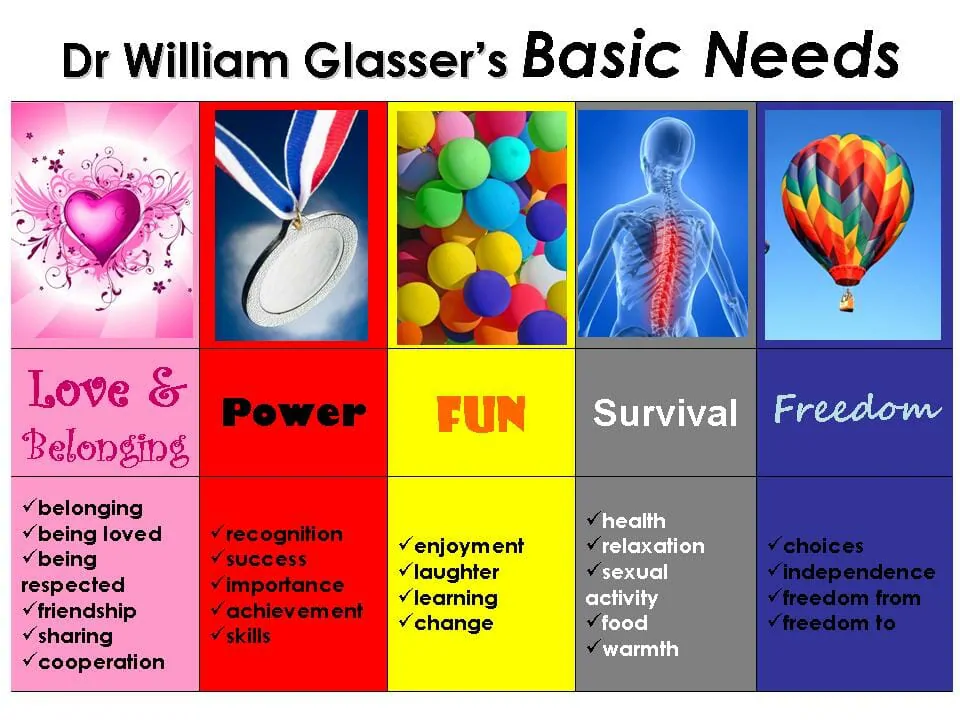
Dr. William Glasser’s 5 Basic Needs

Dr. William Glasser is an American psychiatrist who developed the Reality Theory, which later on became known as the Choice Theory. In the seventies, Glasser’s work was not highly accepted by his colleagues.

While others thought that human behavior is affected by external sources, Glasser believed in personal choice, personal responsibility, and personal transformation. While others considered certain behaviors as mental disorders and prescribed medication for these, Glasser believed in the education and empowerment of his clients to change their choices. He applied his theories on education, management, and marriage.

The Choice Theory states that a person’s behavior is inspired by what that person wants or needs at that particular time, not an outside stimulus. Glasser thought all living creatures control their behavior to fulfill their need for satisfaction in one or more of these five areas:

Read Choice Theory: Be Happy in Life »

Published: September 19, 2013 by Ronit Baras
Last modified: November 28, 2022In: Personal Development, Life Coaching Tags: language, personal development / personal growth / personality development / self improvement, beliefs, identity, guilt, gratitude, happiness, emotional development, responsibility, Life Coaching, practical parenting / parents, values, perception, success, compassion, emotional intelligence, needs, choice, positive, trust, acceptance / judgment / tolerance, failure, self confidence / self esteem / self worth

Body Image

Body image: woman looking at a portrait of her body

The image of the ideal woman’s body has changed over the years. The change becomes obvious when you compare pictures today to pictures taken around the 17th century. The woman in the photo on the right was considered a symbol of the ultimate beauty back then.

Today, she would be considered obese. She would not dare pose for any person trying to sketch her and most definitely not naked.

You might be thinking that the 17th century was a long time ago and this photo is quite old. To this I would say that there is a woman who has been considered beautiful much more recently, and by today’s standards, she too would be considered fat: Marilyn Monroe.

Read Body Image »

Published: July 2, 2013 by Ronit Baras
Last modified: November 9, 2021In: Beautiful people Tags: advertising, identity, change, overweight, society, perception, video, obesity, women, acceptance / judgment / tolerance, body image, appearance, anxiety, media, beliefs

Happiness and Cognitive Behavioral Therapy

My mission today is to convince you, my readers, that even though we dedicate most of our energy to changing the circumstances of our lives, we would better off using most of it to change the beliefs that are causing them.

Every thought in our minds is either weak or strong, healthy or unhealthy for us. It is amazing how much energy we dedicate to strengthening each of our beliefs, whether they are healthy for us or not. This is done at a completely subconscious level. Whatever we think is an interpretation of the things around us, which we distort and delete to support our beliefs. If we think we are awesome and wonderful, we will interpret, delete and distort what is happening to us to strengthen this belief. Next time, our belief that we are awesome and wonderful will be even more solid. It is unfortunate that in the same way, if we think we are worthless and helpless, we will interpret, delete and distort what is happening to us to strengthen this belief. The thought that we are helpless and worthless gets more and more solid.

As you can see from my example, strengthening our beliefs works to our advantage only if we have healthy beliefs. It causes us discomfort and pain if we hold unhealthy ones.

Read Happiness and Cognitive Behavioral Therapy »

Published: March 14, 2013 by Ronit Baras
Last modified: December 25, 2019In: Personal Development Tags: self-talk, interpretation, self confidence / self esteem / self worth, personal development / personal growth / personality development / self improvement, emotions, thought, emotional intelligence, beliefs, mind, happiness, perception

Be Yourself: Everyone Else is Taken

We all go through a journey to define ourselves and develop our self-identity. Be the person you want to be instead of the person others want you to be.

During a very tough time in my life, I started a search to find out who I was and define my “self”. Much like everyone else, I grew up in a society in which the “self” was a very vague concept that kids never considered. I was 16. I went through a bit of crisis when I discovered that I did not know who “I” was. I needed to find and define “me”, to make the choice to be myself.

The second step of my journey was during the first year of my degree. I was studying psychology with one of the most incredible teachers I have ever met when I realized that self-concept, regardless of when you start defining, is something we all have to figure out. In our very first lesson, the teacher walked into a room full of students and asked, “Who are you?”. It sounded like such a simple questions, but we struggled, big time!

Read Be Yourself: Everyone Else is Taken »

Published: December 4, 2012 by Ronit Baras
Last modified: December 25, 2019In: Personal Development Tags: self confidence / self esteem / self worth, control, personal development / personal growth / personality development / self improvement, identity, happiness, practical parenting / parents, motivation, teaching / teachers, Life Coaching, teen books, perception, focus, relaxation, projection, positive, emotional intelligence, acceptance / judgment / tolerance, choice

The Art of Letting Go: Trapped by Labels

Creating labels is another function we use in order to help us survive this world. Humans use labeling to manage the complexity of our environment.

Think about schooling. We send all the kids within a date range to 1st Grade when the difference in age between them is much higher than that between the youngest child in 2nd Grade and the oldest child in 1st Grade (could be just one or two days). We have built a whole education system on that huge range of 365 days, in which kids were born at different times of the day, have different family structures, live with a different number of other people in the same house, come from different socio-economic backgrounds and have different interests. Still, we categorize them all as 1st Graders.

Labeling is part of our day-to-day life. We do it for our own sake and not necessarily for the sake of those we label.

If you take 1,000 random people and put them next to each other, you will not find two that have the exact same skin color or the exact same hobbies. Yet, we often label people by skin color or say they all love drawing, although their skin is different in shade and texture and some love drawing animals, some prefer to draw plants and each person uses a different technique.

In 1930, Linguist Benjamin Whorf came up with the “linguistic relativity hypothesis”. According to him, the words we use not only describe what we see, but actually determine what we see.

Read The Art of Letting Go: Trapped by Labels »

Published: September 25, 2012 by Ronit Baras
Last modified: December 25, 2019In: Personal Development Tags: focus, positive, projection, acceptance / judgment / tolerance, school, behavior / discipline, emotional intelligence, self confidence / self esteem / self worth, how to, personal development / personal growth / personality development / self improvement, choice, negative, wisdom, change, perception, communication, self-fulfilling prophecy

Troublemaker

Ian’s parents came for coaching about 5 years ago. Ian’s mom, Lou, booked the sessions as a last resort before she divorced his dad. About two months ago, she sent me an email and said, “Hi Ronit, Dave and I renewed our vows last year on an overseas trip. I want you to see Ian. He’s in trouble at school”.

Kids’ coaching is not something that most parents understand, but Lou and Dave, after making a huge change in their own life through coaching, did not need to ask what it was. When I called Lou and asked what she needed and why she wanted Ian to come and see me, she said, “Ronit, I’m not sure how you do what you do, but I need you to do it for Ian. He’s a great kid, but he’s in trouble at school and it’s affecting his self-esteem. It breaks my heart to see him like that. I’ve tried different things, but he is still in trouble. I’m sure if he spends some time with you, he’ll gain some confidence, just like we did”.

Ian was one of the most beautiful 11-year-old boys I had ever seen. In his first session, I went over some assessments to figure out what was making him get in trouble at school. Although he could read high-level books, thought math was easy and schoolwork was not a challenge at all, his grade average was “B”. Not that I think everyone needs to get an “A”, but all my assessments showed he was an “A” student, maybe even one of those smart kids that find school so boring they stir up some trouble to get some attention and make things a bit more interesting.

Read Troublemaker »

Published: August 17, 2012 by Ronit Baras
Last modified: March 19, 2021In: Parenting, Education / Learning Tags: success, attitude, emotional intelligence, kids / children, how to, beliefs, acceptance / judgment / tolerance, identity, behavior / discipline, motivation, self confidence / self esteem / self worth, perception, education / learning, self-fulfilling prophecy, practical parenting / parents, communication, k-12 education, projection, tutoring, school, academic performance

How to Change Habits: Flexibility of the Mind

This is your self-help guide to changing habits. Now that you know about types of habits and how they are formed and you know how habits affect your life, it is time to take control of your life by breaking limiting habits and creating new, empowering ones, instead.

Write down 10 recurring situations or outcomes in your life that you are not happy with.

Decide which category they are in
Ask yourself what is you think, feel, say or do that brings you into each situation or gets you each outcome.

Check if the items on your list have anything in common.

Take yourself into one of those events in your mind and experience it again. Look around and try to discover the exact circumstances in that situation. Are you tired? Worried? Has something else happened that day? The day before? Are you hungry? Write as many details as you can. If you do it for the 10 items, you will find a pattern.

Take yourself to the one of those events again. This time, pay attention to the way you feel.
What scares you about what happened? Stay in that situation until you find out what you are afraid of. When this fear first formed, it made you develop the habit to overcome it or manage it.
We all develop habits to help us cope better. Sometimes the habits are not updated. They were appropriate 30, 20, 10 years ago, but may not be appropriate under different circumstance. We are just not the same people.

Read How to Change Habits: Flexibility of the Mind »

Published: August 13, 2012 by Ronit Baras
Last modified: December 25, 2019In: Personal Development Tags: flexibility, how to, time management, fear, acceptance / judgment / tolerance, choice, behavior / discipline, beliefs, personal development / personal growth / personality development / self improvement, change, relationships / marriage, perception, lifestyle, focus, television, projection, tv, emotional intelligence

What Does the Future Hold for Our Kids?

Hey Matthew music video

If I gave every parent a peek into the future, most parents would want to know what would become of their children. We dedicate a lot of time, effort and love to get them to a good place and even a glimpse 10 minutes into the future could really help us direct our actions.

Eden had to raise a virtual child in a computer program for a course in psychology. I thought it was great fun. The rumors were that some of the virtual kids in the program had died or had gotten into lots of trouble before they had reached the age of 18, which was the end of the “parenting game”. Eden’s daughter was gorgeous, happy and successful.

I told Eden that her real daughter would be even better, because the choices the program allowed her to choose from were limited to 4 options, when in reality, you typically have many more options.

As Eden “played” the game, I started thinking it was a good learning tool for parents – not 100% realistic and I would not let any computer program or statistical research help me raise my child – but I really thought it was interesting to know how different parenting styles result in different behaviors in children. In a way, I thought the game was the closest thing to predicting your child’s future.

Read What Does the Future Hold for Our Kids? »

Published: August 10, 2012 by Ronit Baras
Last modified: November 9, 2021In: Parenting Tags: lifestyle, vision, television, projection, tv, responsibility, self-fulfilling prophecy, inspiration, video, emotional intelligence, kids / children, choice, practical parenting / parents, violence, optimism, society, perception

How to Keep an Open Mind

Car covered in grass and sunflowers

As soon as you start any personal development, you bump into the term “beliefs”. These are thought patterns that are set in our mind, mental shortcuts we use to make decisions quickly. The catch is that by not questioning our beliefs, we no longer keep an open mind about everything and sometimes, keeping an open mind is just what we need.

Imagine you are learning to drive. Every little task requires mental effort and after driving around for half an hour, you get out of the car feeling exhausted. Over time and with practice, however, you get the hang of it and then you just go where you want to go.

Now, imagine you’ve been driving on the right side of the road for 10 or 15 years. And you move to a country where people drive on the left side of the road. Continuing to believe in your training and to assume that everyone drives on the right side of the road can be fatal.

Read How to Keep an Open Mind »

Published: August 8, 2012 by Gal Baras
Last modified: October 27, 2020In: Personal Development Tags: change, happiness, Life Coaching, relationships / marriage, communication, perception, projection, self-fulfilling prophecy, emotional intelligence, self-talk, how to, interpretation, choice, acceptance / judgment / tolerance, beliefs, personal development / personal growth / personality development / self improvement, rules

Best Anger Management Tips and Quotes

Hulk - the symbol of bad anger management

If you kick a stone in anger, you’ll hurt your own foot
– Korean Proverb

Some people are angry. Most of them learn anger from their parents and are trapped in a vicious cycle. One of the saddest things is an angry family, in which the parents are angry at the kids, who are angry at their parents, who are angry at their kids…

Sounds familiar?

Anger always comes from frustrated expectations
– Elliott Larson

Some say anger peaks during the teen years. I am not sure this is true for everyone. I know many teens who are joyful and happy. I was angry until I became a teenager, so I believe anger has nothing to do with age and hormones and everything to do with awareness. I think anger is a mindset that clutters our thinking and we are angry because we have poisoned ourselves with thoughts of disappointment and frustration.

For every minute you are angry, you lose sixty seconds of happiness
– Ralph Waldo Emerson

Let’s face it, we are all angry at times. We are angry when things do not happen the way we want them to. Anger is a form of extreme disappointment that we think we are directing towards what we believe to be the source of the disappointment, but in fact, we direct it only towards ourselves. When I think of anger, I immediately see a bottle of poison.

Read Best Anger Management Tips and Quotes »

Published: July 6, 2012 by Ronit Baras
Last modified: March 19, 2021In: Personal Development, Parenting, Relationships / Marriage Tags: choice, personal development / personal growth / personality development / self improvement, violence, practical parenting / parents, wisdom, relationships / marriage, perception, communication, relaxation, projection, kids / children, love, stress / pressure, emotional intelligence, acceptance / judgment / tolerance, how to, behavior / discipline, fear, self confidence / self esteem / self worth

  • « Go to Previous Page
  • Page 1
  • Interim pages omitted …
  • Page 3
  • Page 4
  • Page 5
  • Page 6
  • Page 7
  • Page 8
  • Go to Next Page »

Get Happiness by Email

Sign up to receive posts by email and get my free mini-course Seven Emails with Seven Secrets for Seven Weeks to boost your personal development


    Books by Ronit Baras

    • What motivates your child? Read Motivating Kids by Ronit Baras Motivating Kids From: $9.95
    • Reflections by Ronit Baras Reflections From: $5.99
    • Be Special Be Yourself for Teenagers by Ronit Baras Be Special, Be Yourself for Teenagers From: $5.99
    • In the Outback with Jasmine Banks by Ronit Baras In the Outback with Jasmine Banks From: $5.99
    • The Will by Ronit Baras The Will From: $5.99

    Be Happy in LIFE logo
    Book your private life coaching with Ronit Baras and learn how to be happy in life

    Girl speaking at student leadership programLeaders are not born. They are made. Bring this Student Leadership Program to your primary school or high school and you will create a community of empowered, inspired student leaders, parents and teachers.

    Related Links

    • Be Happy in LIFE – Life Coaching
    • Personal Growth Web
    • Tsoof Baras – percussionist, composer and producer
    • Noff Baras – Screen Actor & Model

    Primary Sidebar

    Your Cart

    Ready to be happy?

    Happy woman holding a cup in the snow
    Be empowered and set your spirit free!

    Engage Ronit as Your Life Coach »

    Speaker Bookings

    Ronit Baras - Practical Parenting Blogger
    Book Ronit as a Speaker for Your event »

    Join Us on Social Media

    Facebook logo Twitter logo Linkedin logo Pinterest logo RSS feed icon

    Give to Receive

    Kiva - loans that change lives

    Contact Us · Subscribe · Terms of Use / Privacy Statement · Return & Refund Policy · Sitemap

    Copyright © 2026 Be Happy in LIFE · Built and powered by Get Business Online

    Secure HTTPS

    • Home
    • Series
    • About Ronit Baras
    • Books by Ronit Baras
      ▼
      • Motivating Kids
      • Be Special, Be Yourself for Teenagers
      • Reflections
      • In the Outback with Jasmine Banks
      • The Will
      • * Your Cart
      • * Secure Checkout
    • Contact
      ▼
      • Join Us